Linea alba (Latin: linea alba)
Also called: white line (of the abdomen)
rectus
abdominis
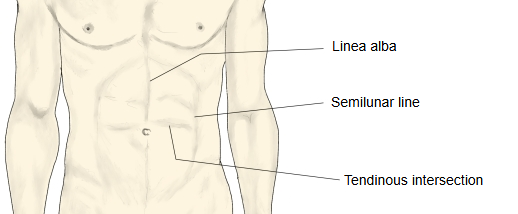
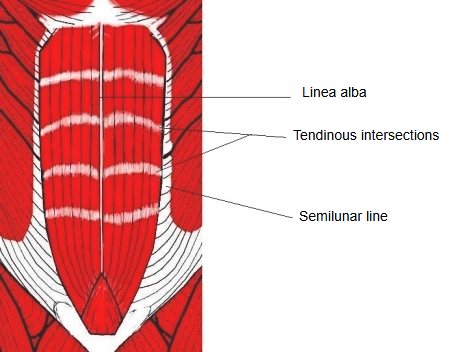
- Linea alba : a single line of connective tissue running vertically down the middle (the midline) between the right and left rectus abdominis
- Tendinous intersections : 3–4 bands of connective tissue that cross the belly of rectus abdominis and divide it into segments
- Semilunar line : 2 lines, one on each side, curving along the lateral edge of rectus abdominis
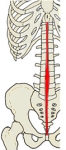 Linea alba
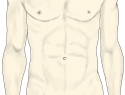 Surface of the abdomen
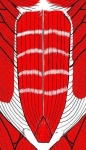 Rectus abdominis and its lines
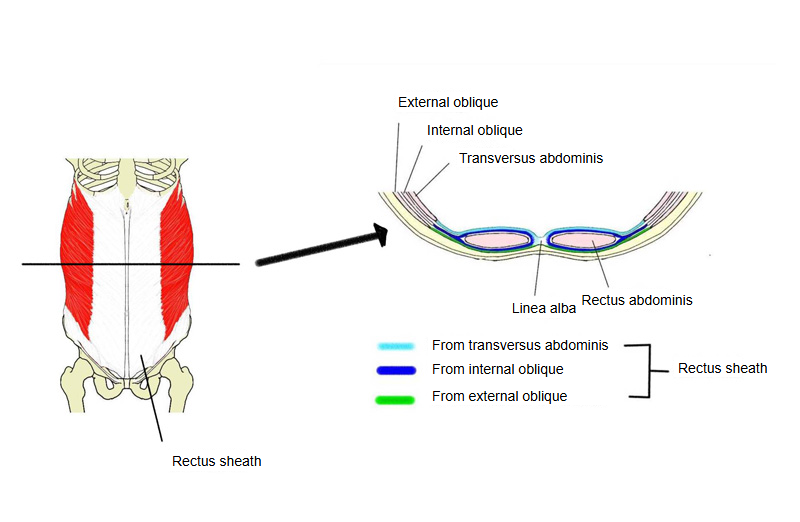
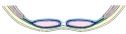 Rectus sheath (transverse section)
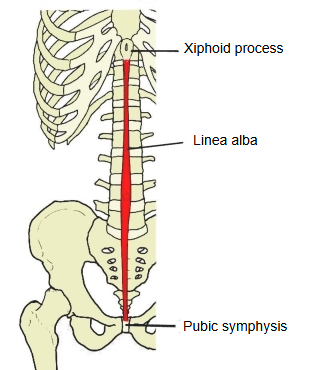
The linea alba is formed mainly by aponeurotic fibres of the broad abdominal muscles that cross from one side to the other; there are also longitudinal fibres, which continue above from the xiphoid process and below from a small triangular band behind its lower end (the adminiculum lineae albae), which arises from the upper border of the pubic symphysis and anchors it there. Above the umbilicus it is a broader band; below the umbilicus it narrows almost to a line but becomes thicker from front to back. The umbilical ring lies in it: before birth the umbilical vessels pass through this opening, and after birth it closes as their remnants scar and fuse with the ring and the skin. A weaker spot can remain at its upper part, where the umbilical vein passed; this plays a large part in acquired umbilical hernia.
Structure
The linea alba runs from the xiphoid process to the pubic symphysis down the midline of the abdomen, between the right and left rectus abdominis muscles. It is formed where the aponeuroses of the external oblique, internal oblique and transversus abdominis of both sides meet and interlace in the midline, after enclosing rectus abdominis as the rectus sheath. It is made mostly of collagen-rich dense connective tissue, which gives it its white colour and its name ("white line"). Together with the paired semilunar lines and the tendinous intersections, it shapes the surface of the front abdominal wall; in lean, muscular people it shows as a vertical groove between the two halves of the rectus abdominis. Being tough and poorly supplied with vessels, it is a common route for midline incisions, and also a site of epigastric and umbilical hernias and of separation of the recti (diastasis recti).
Function
By linking the flat abdominal muscles of the two sides, it balances their pull and stabilises the front abdominal wall.
Reference websites
[Wikipedia]
· Linea alba (abdomen), Wikipedia.
[Websites with illustrations]
· Linea alba (Kenhub)

· Linea alba (The Free Dictionary (Mosby's Medical Dictionary))

· Aponeuroses of the lateral abdominal muscles forming the linea alba (antranik.org)

Related terms
- Rectus abdominis
- External oblique
- Internal oblique
- Transversus abdominis
- Xiphoid process
- Pubic symphysis
References and sources
- Further reading: Linea alba (abdomen), Wikipedia.
- Federative International Programme for Anatomical Terminology (FIPAT). Terminologia Anatomica, 2nd ed. (TA2), 2019.