Fovea laminae
Also called the depression of the cricoid lamina
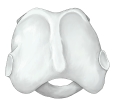 Cricoid cartilage (posterior view)
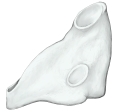 Cricoid cartilage (posterolateral view)
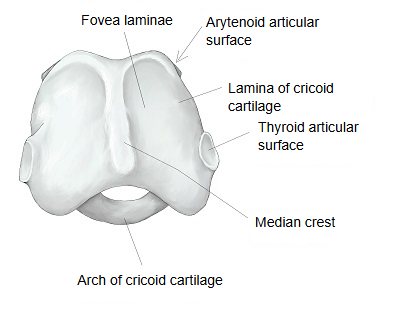
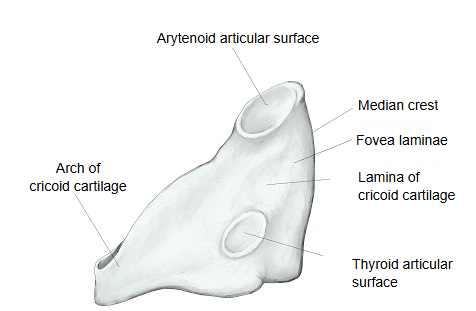
The cricoid cartilage is an unpaired ring of hyaline cartilage below the thyroid cartilage, at the lower end of the larynx; below, it is joined to the first tracheal cartilage by the cricotracheal ligament. It is shaped like a signet ring and becomes much taller from front to back. The narrow front part is the arch; the back part widens into a square plate, the lamina. A vertical ridge, the median crest, runs down the middle of the back of the lamina; on each side of it is a depression, the fovea laminae, from which the posterior cricoarytenoid muscle arises. Where the lamina meets the arch there is a small round joint surface, the thyroid articular surface, which articulates with the articular facet for the cricoid cartilage on the inferior horn of the thyroid cartilage. The upper border of the lamina is notched in the middle, and on each side of the notch is an oval joint surface, the arytenoid articular surface, on which the arytenoid cartilage rests.
The median crest between the two foveae gives attachment to the longitudinal muscle of the oesophagus. The posterior cricoarytenoid is the only muscle that opens the rima glottidis, by turning the vocal processes of the arytenoid cartilages outwards. The term is not listed in Terminologia Anatomica; many texts simply describe a depression on each side of the median ridge.
Related terms
- Rima glottidis
- Glottis
- Vocal fold
- Posterior cricoarytenoid ligament
- Cricothyroid
- Laryngeal prominence
- Larynx
References and sources
- Further reading: Cricoid cartilage, Wikipedia.
- Further reading: Posterior cricoarytenoid muscle, Wikipedia.
- Federative International Programme for Anatomical Terminology (FIPAT). Terminologia Anatomica, 2nd ed. (TA2), 2019.