Amphiarthrosis (Latin: amphiarthrosis)
Also called the slightly movable joint
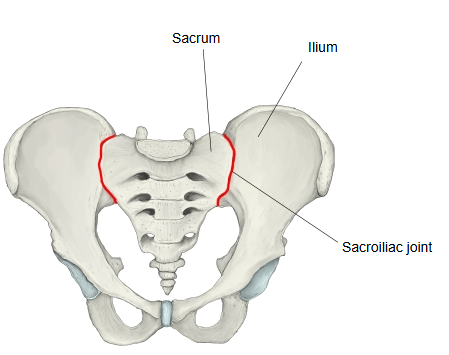
Example: the sacroiliac joint.
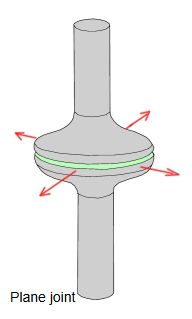
· Among the plane joints, the sacroiliac joint has many small bumps and hollows on both articular surfaces and hardly moves at all; it is therefore called an amphiarthrosis.
(synovial joints)
- Uniaxial joints : move about one axis only (hinge joint, spiral joint, pivot joint).
- Biaxial joints : move about two axes that cross each other (ellipsoid joint (= condylar joint), saddle joint).
- Multiaxial joints : move about three or more axes (ball-and-socket joint (including the enarthrosis), plane joint (including the amphiarthrosis)).
The word is used in two ways. In most English-language texts it means a slightly movable cartilaginous joint, especially a symphysis joined by fibrocartilage, such as the pubic symphysis and the joints between the vertebral bodies; some texts also include fibrous joints joined by an interosseous membrane, as between the tibia and fibula (the tibiofibular syndesmosis). In German usage it means, in the narrow sense, a joint with very little movement, also called a close joint: a variant of the synovial joint that moves only slightly because of its strong ligaments, tough articular capsule and, in many cases, uneven articular surfaces, for example the sacroiliac joint. It is contrasted with freely movable joints (diarthroses) and immovable joints (synarthroses).
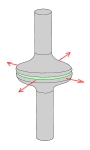 Plane joint (schematic)
 Sacroiliac joint
Reference websites
[Wikipedia]
· Amphiarthrosis, Wikipedia.
· Joint, Wikipedia.
Related terms
References and sources
- Further reading: Amphiarthrosis, Wikipedia.
- Further reading: Joint, Wikipedia.
- Federative International Programme for Anatomical Terminology (FIPAT). Terminologia Anatomica, 2nd ed. (TA2), 2019.