Condylar joint (Latin: articulatio condylaris)
Also called the ellipsoid joint
Examples: the radiocarpal joint and the atlanto-occipital joint.
· Some sources distinguish the condylar joint from the ellipsoid joint; they keep the name condylar (bicondylar) joint for joints with two condyles, such as the knee joint and the temporomandibular joint.
joints
- Uniaxial joints : move about one axis only: hinge joints, spiral joints and pivot joints.
- Biaxial joints : move about two axes at right angles: ellipsoid joints (= condylar joints) and saddle joints.
- Multiaxial joints : move about three or more axes: ball-and-socket joints (enarthroses) and plane joints.
In classifications by the shape of the joint surfaces and the kind of movement, the condylar joint and the ellipsoid joint are often treated as one and the same joint.
The articular head is not a sphere but an oval convex surface, longer in one direction, and the socket is a matching oval concave surface. Its range of movement is therefore much smaller than that of a ball-and-socket joint; it is a biaxial joint that moves about the long and the short axis (flexion and extension, abduction and adduction, combined as circumduction), but axial rotation is not possible.
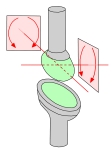 Ellipsoid joint (model)
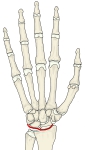 Radiocarpal joint
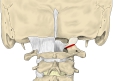 Atlanto-occipital joint
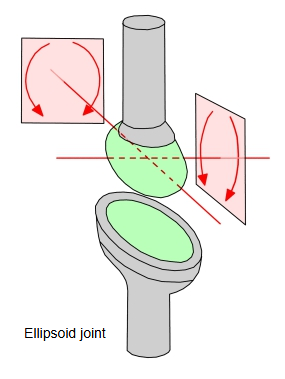
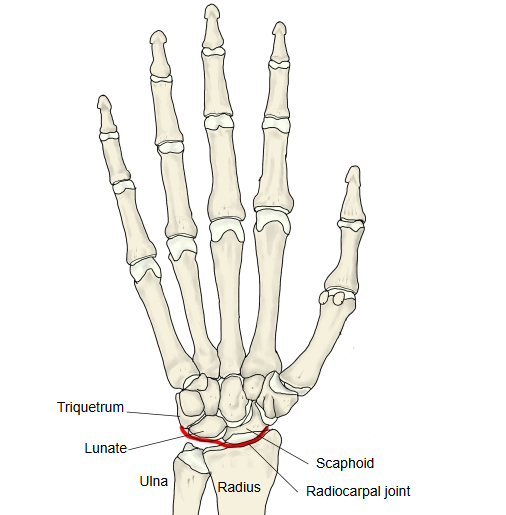
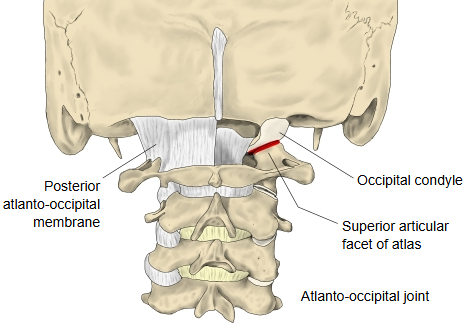
Reference websites
[Wikipedia]
· Condyloid joint, Wikipedia.
[Websites with illustrations]
· Condyloid joint (model, e.g. the radiocarpal joint) (Radiopaedia)

Examples
Examples include:
the wrist joint (radiocarpal joint)
the metacarpophalangeal joints
the metatarsophalangeal joints
Related terms
- Radiocarpal joint
- Atlanto-occipital joint
- Metacarpophalangeal joints
- Knee joint
- Temporomandibular joint
- Plane joint
References and sources
- Further reading: Condyloid joint, Wikipedia.
- Federative International Programme for Anatomical Terminology (FIPAT). Terminologia Anatomica, 2nd ed. (TA2), 2019.