Spiral joint (Latin: articulatio cochlearis)
Also called the cochlear joint or the screw joint
· It is best seen as a variety of hinge joint: one joint surface carries a ridge and the other a matching groove. Because they are not exactly at right angles to the long axis of the bone, flexion is accompanied by a slight sideways shift, and the moving bone follows a spiral path. Like a hinge joint it is uniaxial.
· In other words, it is a hinge joint in which bending and straightening are combined with a small sliding along the axis of movement; in humans the spiral movement is only slight. Sources differ: most English texts do not list the spiral joint as a separate type and simply call these joints hinge joints.
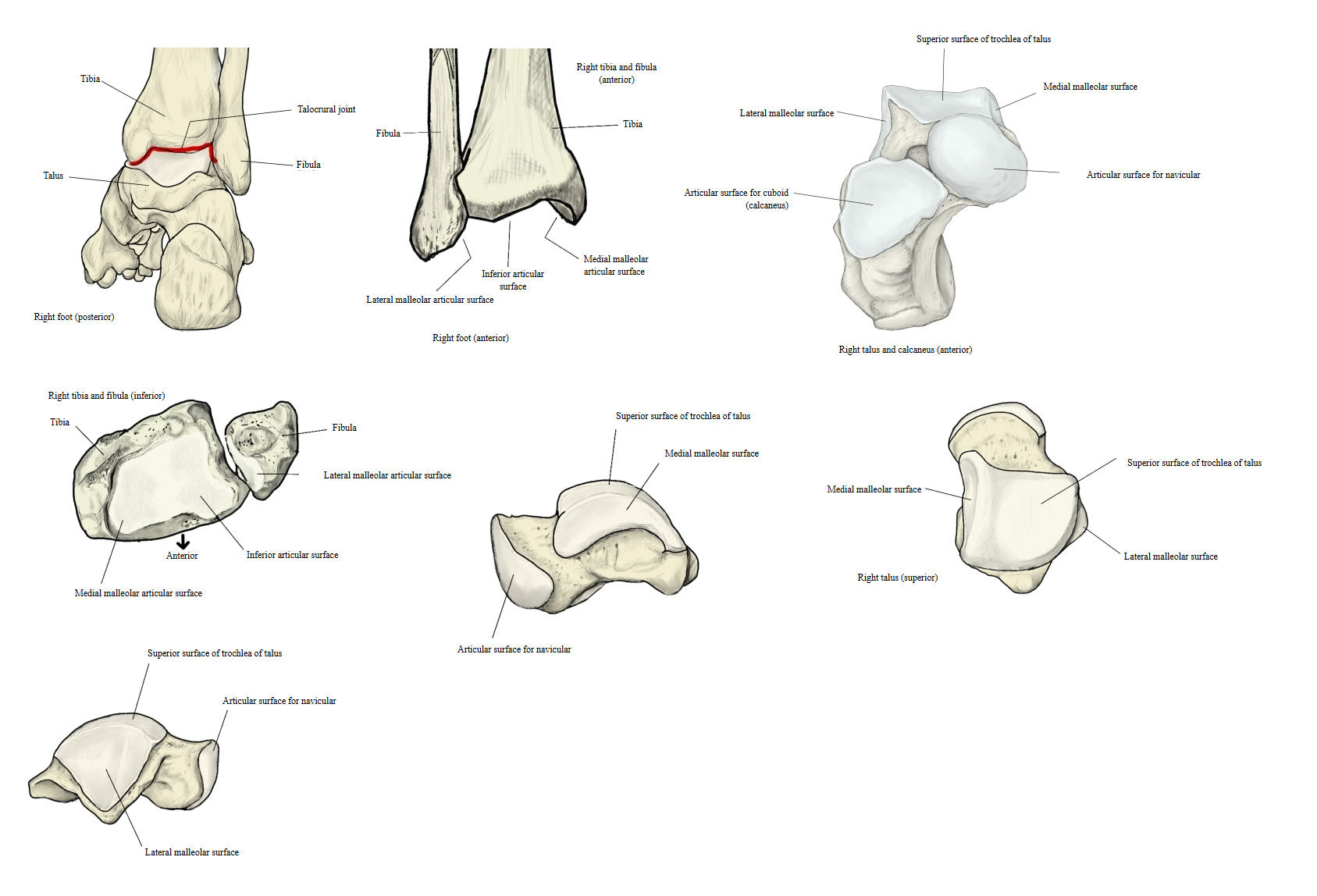
Examples: the talocrural joint; also the humeroulnar joint.
(synovial joints)
- Uniaxial joints : move about one axis only (hinge joint, spiral joint, pivot joint).
- Biaxial joints : move about two axes that cross each other (ellipsoid joint (= condylar joint), saddle joint).
- Multiaxial joints : move about three or more axes (ball-and-socket joint (including the enarthrosis), plane joint).
In a hinge joint both joint surfaces are parts of a cylinder, so movement is possible in one direction only. The knee joint, the elbow (humeroulnar joint), the talocrural joint and the interphalangeal joints belong here. Except for the interphalangeal joints, their axis of movement traces a slight spiral; this is called a spiral joint (for example the humeroulnar joint, between the trochlea of the humerus and the trochlear notch of the ulna).
Related terms
- Humeroulnar joint
- Talocrural joint
- Knee joint
- Condylar joint
- Saddle joint
- Ball-and-socket joint
- Plane joint
References and sources
- Further reading: Hinge joint, Wikipedia.
- Federative International Programme for Anatomical Terminology (FIPAT). Terminologia Anatomica, 2nd ed. (TA2), 2019.