Enarthrosis (Latin: enarthrosis; articulatio cotylica)
Also called the cotyloid joint
An enarthrosis is one kind of movable joint, a multiaxial joint: a ball-and-socket joint in which the articular head fits deeply into the socket.
Movable joint: a joint in the narrow sense (a synovial joint)Deeply: according to some sources, the socket encloses more than half of the head
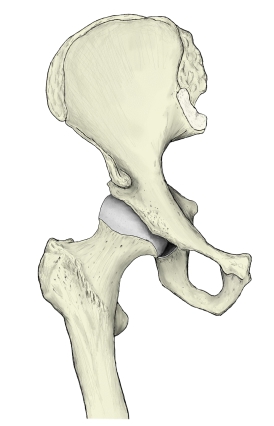
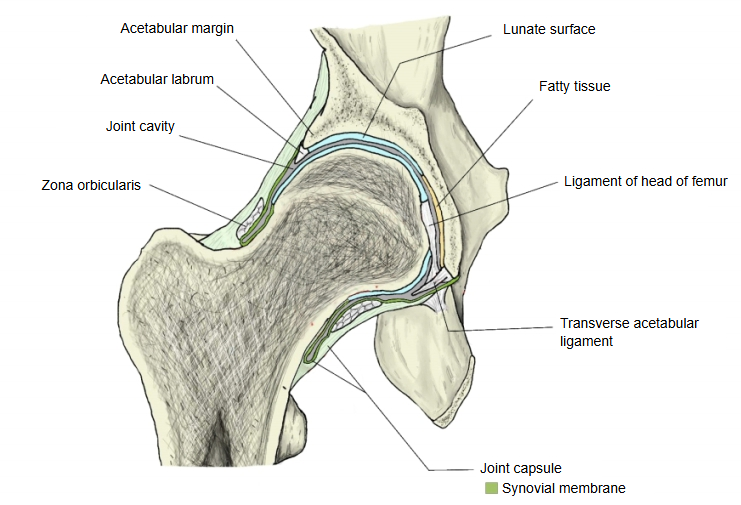
Example: the hip joint, where the acetabulum, deepened by the acetabular labrum, holds the head of the femur.
Like a ball-and-socket joint it can move in all directions, but its range of movement is smaller than that of a ball-and-socket joint.
Because the head fits deeply into the socket. In return the joint is more stable than a shallow ball-and-socket joint such as the shoulder joint.
Note: some sources do not distinguish the ball-and-socket joint from the enarthrosis. Some textbooks keep the two apart, while English Wikipedia, for example, gives enarthrosis simply as another name for the ball-and-socket joint.
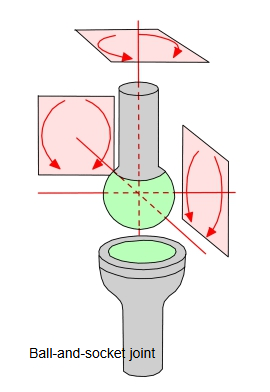
Like other ball-and-socket joints, the enarthrosis allows flexion and extension, abduction and adduction, rotation and circumduction.
Movable joints
(synovial joints)
(synovial joints)
- Uniaxial joints : move about one axis only (hinge joint, spiral joint, pivot joint).
- Biaxial joints : move about two axes that cross each other (ellipsoid joint (= condylar joint), saddle joint).
- Multiaxial joints : move about three or more axes (ball-and-socket joint (including the enarthrosis), plane joint (including the amphiarthrosis)).
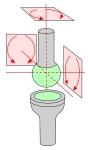 Ball-and-socket joint (model)
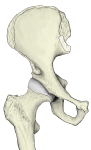 Hip joint
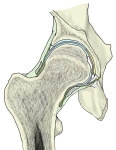 Hip joint (coronal section)
Reference websites
[Wikipedia]
· Ball-and-socket joint, Wikipedia.
[Websites with illustrations]
· Hip joint as a ball-and-socket joint (head of femur and acetabulum, with a movement model) (Pinterest (image))

Related terms
References and sources
- Further reading: Ball-and-socket joint, Wikipedia.
- Federative International Programme for Anatomical Terminology (FIPAT). Terminologia Anatomica, 2nd ed. (TA2), 2019.