Lunula (Latin: lunula unguis)
Also called the lunule
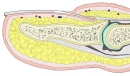 Nail (longitudinal section)
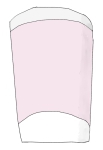 Nail (1)
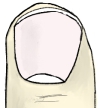 Nail (2)
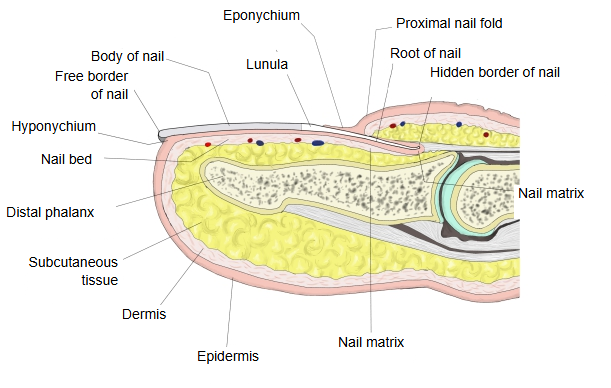
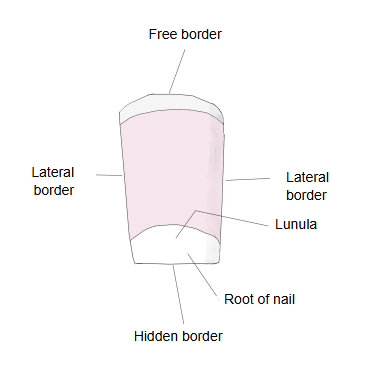
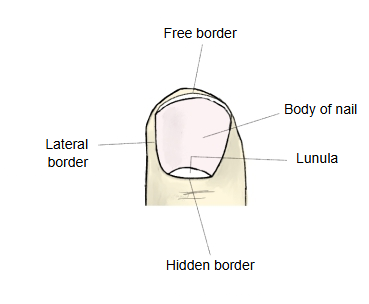
Reference websites
[Wikipedia]
· Lunula (anatomy), Wikipedia.
· Nail (anatomy), Wikipedia.
Appearance
The lunula lies at the base of the nail, the end nearest the skin of the finger, just in front of the posterior nail wall, but it still lies under the nail plate: it is the front part of the nail matrix seen through the nail. It is usually half-moon-shaped. It looks white because the nail there is not yet fully keratinized and the epithelium under it is thick, so the pink of the blood vessels below does not show through; some sources add that the dermis under it is looser and has fewer visible capillaries. It is largest on the thumb; on other fingers it may be small, or partly or wholly hidden under the eponychium (cuticle), and in some people it cannot be seen at all.
Importance
Because the lunula is part of the matrix, where the nail is formed, damage to this region can permanently deform the nail. It is also the newest part of the nail, so changes in its size or colour are sometimes looked at in the examination of the nails.
Related terms
References and sources
- Further reading: Lunula (anatomy), Wikipedia.
- Further reading: Nail (anatomy), Wikipedia.
- Federative International Programme for Anatomical Terminology (FIPAT). Terminologia Anatomica, 2nd ed. (TA2), 2019.