Tonsillar crypts (Latin: cryptae tonsillares)
Supratonsillar fossa: an especially well-developed tonsillar crypt that opens by a narrow mouth into the upper part of the tonsillar fossa; it is also called the intratonsillar cleft.
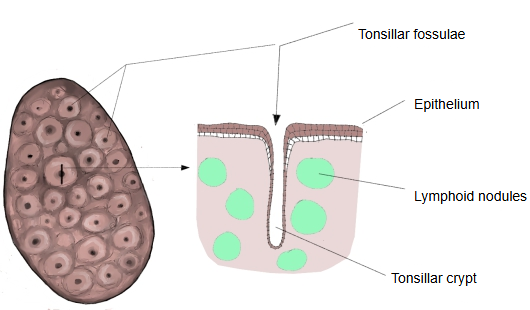
The palatine tonsil is oval, with its long axis vertical; it has medial and lateral surfaces, upper and lower poles, and anterior and posterior borders. The mucosa of its medial surface shows many deep, round depressions, the tonsillar pits, which continue into the tonsillar crypts.
The crypts are best developed in the palatine tonsil, where they are long and branched; the lingual tonsil has shorter, unbranched crypts. They are lined by the surface epithelium and surrounded by lymphoid nodules, which greatly increases the area where the tonsil meets foreign material. Lymphocytes move into the crypt epithelium, and shed cells and debris may collect in the crypts (sometimes forming tonsil stones).
Related terms
References and sources
- Further reading: Palatine tonsil, Wikipedia.
- Further reading: Tonsil, Wikipedia.
- Federative International Programme for Anatomical Terminology (FIPAT). Terminologia Anatomica, 2nd ed. (TA2), 2019.