Tonsil (Latin: tonsilla)
Not a gland
Tonsils used to be called "tonsillar glands", as if they were glands (groups of cells that secrete). They are not true glands, so the name is no longer used.
· Their name refers to their almond-like shape; the Greek word for almond, amygdala, was once used for the tonsils.
Many lymphoid nodules are packed just under the mucous epithelium, and the surface shows clefts (lined by epithelium) and pits.
Function: removing foreign material (bacteria, viruses and so on) that enters through the mouth and the nasal cavity.
Types
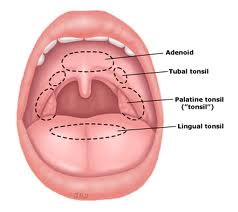
There are four kinds of tonsil. Seen from the front, they form a ring around the openings of the airway and food passage, called Waldeyer's ring (pharyngeal lymphoid ring).
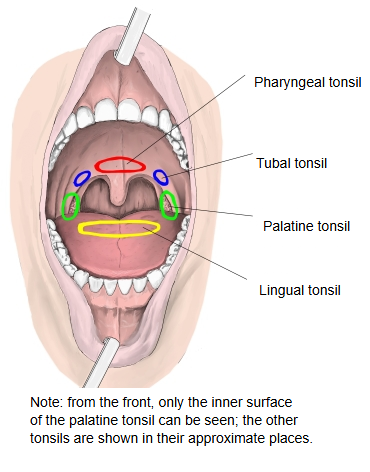
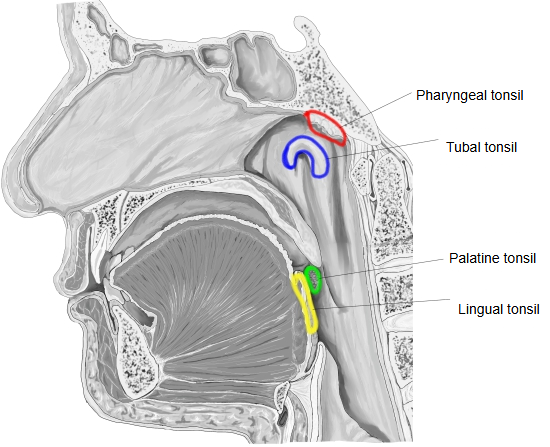
- Palatine tonsil : paired; the largest tonsil, oval, lying in the tonsillar fossa of the fauces; its surface shows the tonsillar pits
- Lingual tonsil : on the surface of the back third of the tongue (root of the tongue); contains densely packed lymphoid nodules
- Tubal tonsil : paired; around the pharyngeal opening of the auditory tube, in the torus tubarius
- Pharyngeal tonsil : single; on the upper part of the back wall of the pharyngeal fornix (nasopharynx); also called the adenoid
 Tonsils (oral cavity from the front)
 Tonsils (median section)
| Tonsil | Epithelium | Crypts | Location |
|---|---|---|---|
| Pharyngeal tonsil (adenoid) | Ciliated pseudostratified columnar (respiratory epithelium) | None (folds instead) | Roof and back wall of the nasopharynx |
| Tubal tonsil | Ciliated pseudostratified columnar (respiratory epithelium) | – | Around the pharyngeal opening of the auditory tube |
| Palatine tonsil | Non-keratinized stratified squamous | Deep, branched | Side wall of the oropharynx, between the palatoglossal and palatopharyngeal arches |
| Lingual tonsil | Non-keratinized stratified squamous | Shorter, unbranched | Root of the tongue, behind the terminal sulcus |
Tonsils are not simply a group of lymph nodes: they are collections of lymphoid nodules under the mucous membrane, with clefts and pits in the surface. The clefts are lined by epithelium; in the palatine tonsil they form deep, blind tonsillar crypts. Lymphocytes and granular white blood cells move into the epithelium of the crypts. Placed where air and food enter, the tonsils meet microorganisms and other foreign material taken in through the mouth and nose and start a local immune response. Used alone, "the tonsils" usually means the palatine tonsils.
Reference websites
[Wikipedia]
· Tonsil, Wikipedia.
· Waldeyer's tonsillar ring, Wikipedia.
[Websites with illustrations]
· Tonsils and throat anatomy (Blausen) (Wikimedia Commons)

· Tubal tonsil (image) (knowyourbody.net)
Related terms
- Palatine tonsil
- Pharyngeal tonsil
- Lingual tonsil
- Isthmus of fauces
- Oropharynx
- Nasopharynx
- Lymph node
References and sources
- Further reading: Tonsil, Wikipedia.
- Further reading: Waldeyer's tonsillar ring, Wikipedia.
- Federative International Programme for Anatomical Terminology (FIPAT). Terminologia Anatomica, 2nd ed. (TA2), 2019.