Isthmus of fauces (Latin: isthmus faucium)
Also called Oropharyngeal isthmus or the faucial isthmus
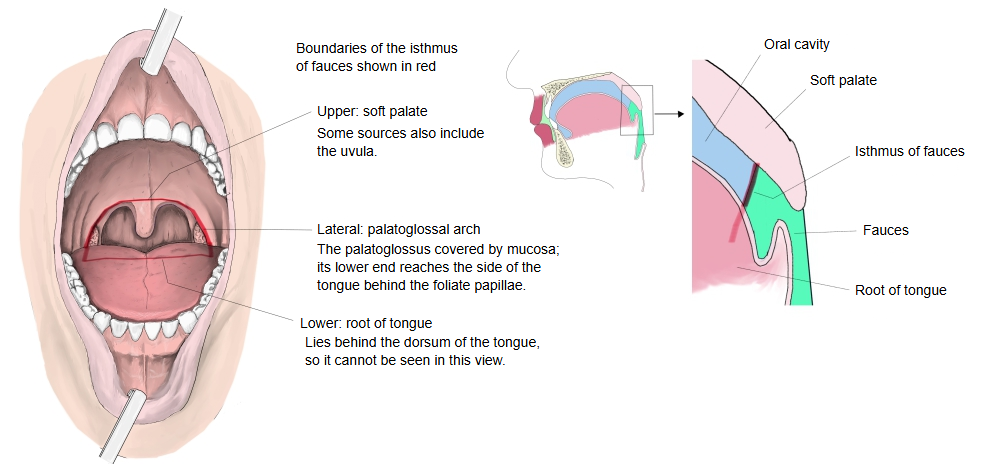
· It has three boundaries:
Above: the soft palate (with the uvula in the middle); on each side: the palatoglossal arch; below: the tongue (root of the tongue).
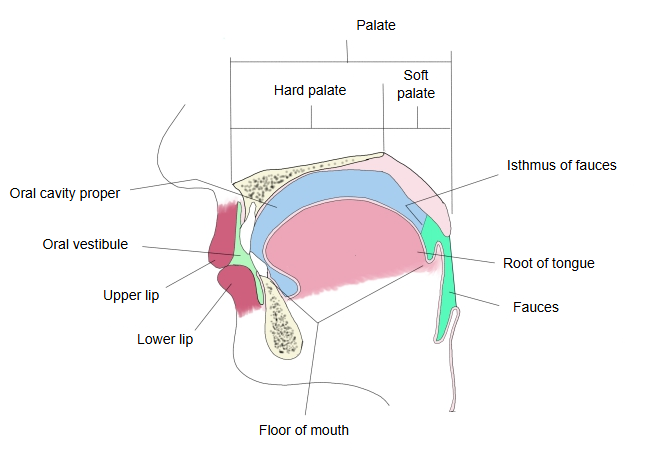
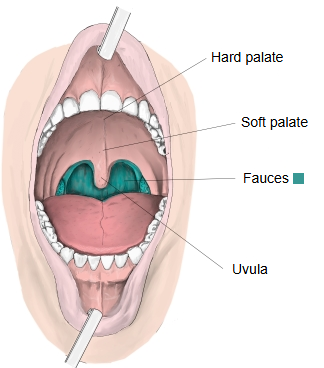
The fauces is the narrow region between the mouth and the pharynx. Its roof is the soft palate, its side walls are the palatine arches and its floor is the root of the tongue. Its narrowest part is the fauces in the strict sense, the isthmus of fauces.
The fauces is the passage from the mouth into the pharynx. Its roof is the soft palate (velum palatinum) and its floor the root of the tongue. Each side wall forms two folds, and the passage is narrowest at the front one: the front fold, on the mouth side, is the palatoglossal arch, a fold of mucosa over the palatoglossus muscle whose lower end reaches the side of the tongue behind the foliate papillae; the back fold, on the pharynx side, is the palatopharyngeal arch. Sources differ in their use of the word: some call only the space between the two arches, where the palatine tonsil lies, the fauces.
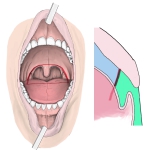 Boundaries of the isthmus of fauces
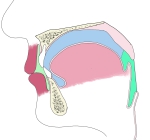 Oral cavity (median section)
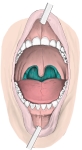 Fauces (anterior view)
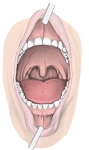 Oral cavity (anterior view)
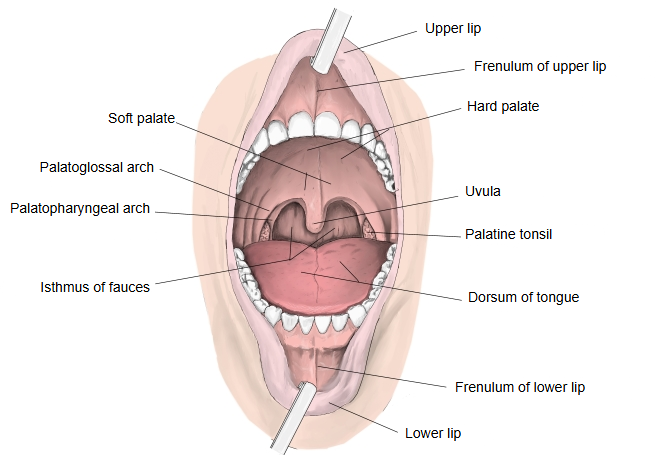
The isthmus lies just behind the mouth cavity, at the entrance to the oropharynx. The two arches on each side are made by the palatoglossus and palatopharyngeus muscles covered with mucosa, with the palatine tonsil between them. When the palatoglossus muscles contract and the tongue is raised, the arches come together and the isthmus narrows or closes; this keeps food in the mouth during chewing. In swallowing it opens to let the food pass into the pharynx and then closes behind it.
Reference websites
[Wikipedia]
· Fauces (throat), Wikipedia.
[Websites with illustrations]
· The oral cavity (TeachMeAnatomy)
· Oropharynx: anatomy, borders and function (Kenhub)
· The mouth cavity (Gray's Anatomy) (Wikimedia Commons)

Where it is found
Related terms
References and sources
- Further reading: Fauces (throat), Wikipedia.
- Federative International Programme for Anatomical Terminology (FIPAT). Terminologia Anatomica, 2nd ed. (TA2), 2019.