Intercalated duct (Latin: Ductus intercalatus)
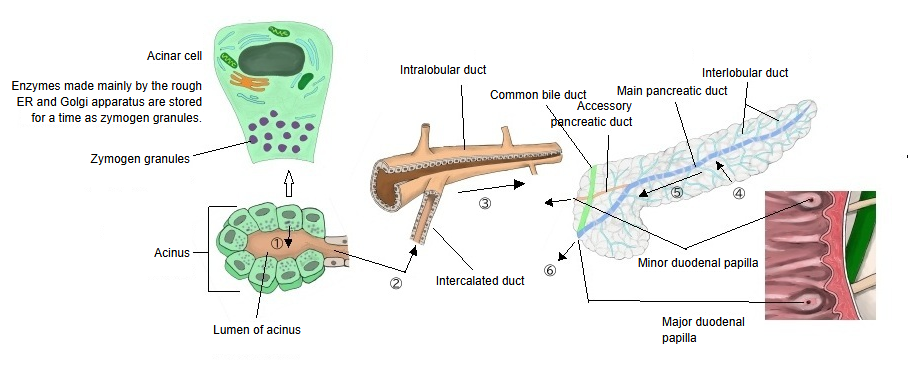
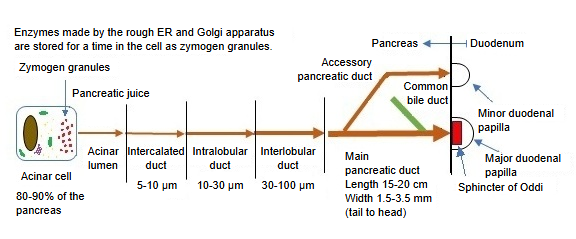
The intercalated duct is one of the ducts that carry the pancreatic juice in the pancreas, a gland with both endocrine and exocrine parts; it is the smallest and first part of the duct system and leads the juice out of the lumen of the acinus.
Pancreatic juice: a body fluid containing digestive enzymes and electrolytesGland: the pancreas has both endocrine and exocrine functionsIt starts inside the acinus, where its first cells are the centroacinar cells, and carries the juice away from the acinar cells
· Its diameter is roughly 5–10 µm; the wall is a single layer of low cuboidal or flat cells, and the lumen is very narrow, only a few micrometres across. The duct cells add water and bicarbonate to the enzyme-rich secretion of the acini, and the juice then flows on through the intralobular and interlobular ducts into the main or accessory pancreatic duct.
· Ducts of the same name are found not only in the pancreas but also in the serous and mixed glands such as the parotid gland, the submandibular gland and the sublingual gland (the salivary glands) and the lacrimal gland; in the salivary glands they lead into the striated ducts.
Related terms
References and sources
- Further reading: Intercalated duct, Wikipedia.
- Further reading: Pancreas, Wikipedia.
- Federative International Programme for Anatomical Terminology (FIPAT). Terminologia Anatomica, 2nd ed. (TA2), 2019.