Latin: glandulae salivariae
Overview
- Exocrine glands of the digestive system that secrete saliva into the oral cavity.
- Saliva moistens food, starts the digestion of starch (amylase), protects the mouth and helps speech and taste.
- Divided into major and minor salivary glands.
- Secretions are serous (thin, watery, enzyme-rich), mucous (thick and slimy) or mixed.
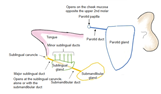
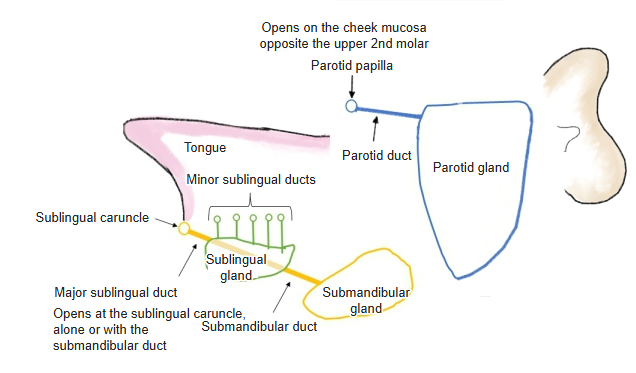
Major salivary glands (schematic) 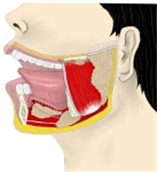
Major salivary glands
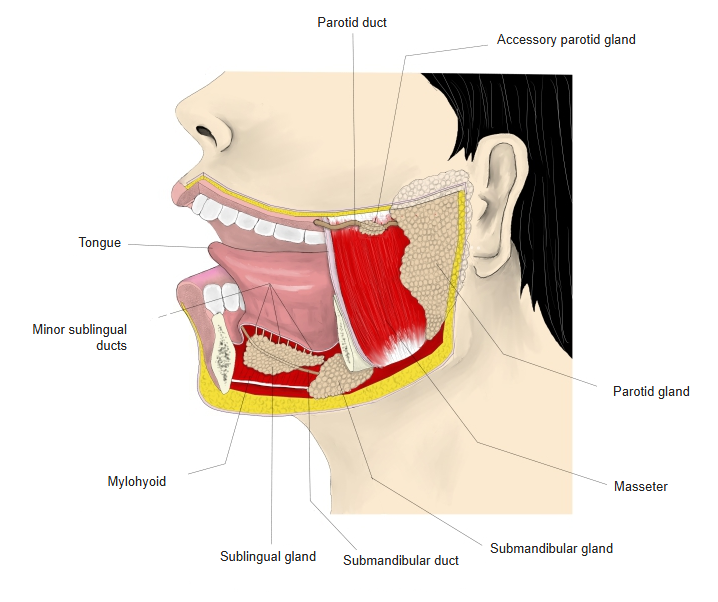
Major salivary glands
| Gland | Site | Secretion | Duct opening |
|---|---|---|---|
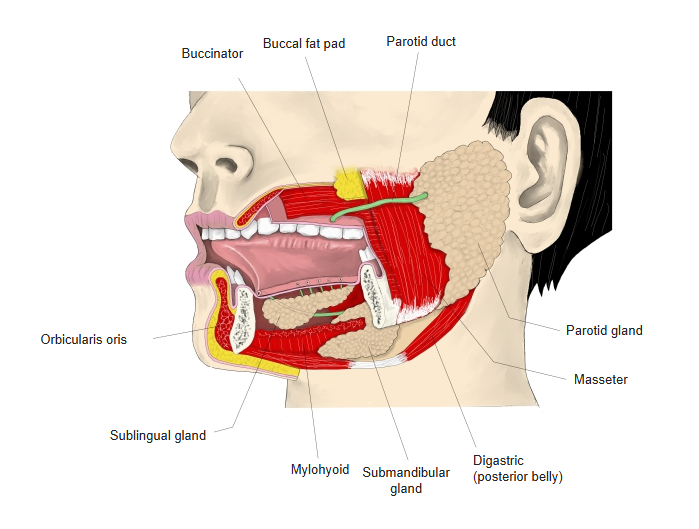
| Parotid gland | In front of and below the ear; the largest | Serous | Parotid duct, on the cheek opposite the upper second molar |
| Submandibular gland | Submandibular triangle, below the mandible | Mixed, mainly serous | Submandibular duct, at the sublingual caruncle |
| Sublingual gland | Floor of the mouth, under the sublingual fold; the smallest | Mixed, mainly mucous | Major sublingual duct (at the caruncle) and minor ducts (along the sublingual fold) |
- The major glands lie at a distance from the oral mucosa and drain through long ducts.
Salivary glands and the cheek muscles
Minor salivary glands
| Gland | Site | Secretion |
|---|---|---|
| Labial glands | Lips | Mixed |
| Buccal glands | Cheeks | Mixed |
| Molar glands | Cheek near the molars | Mixed |
| Palatine glands | Palate | Mucous |
| Lingual glands | Tongue (anterior, posterior and von Ebner glands) | Mixed, mucous, or serous (von Ebner glands) |
- The minor glands lie in the mucosa or submucosa and open directly, or through short ducts, onto the mucosal surface.
References and sources
- Further reading: Salivary glands, Wikipedia.