Pancreatic duct (Latin: ductus pancreaticus)
Also called Main pancreatic duct or the duct of Wirsung
- Overview
- Main pancreatic duct
- Accessory pancreatic duct
- Reference websites
- (Wikipedia, websites with illustrations)
- Where it is found
- Related terms
Overview
ducts
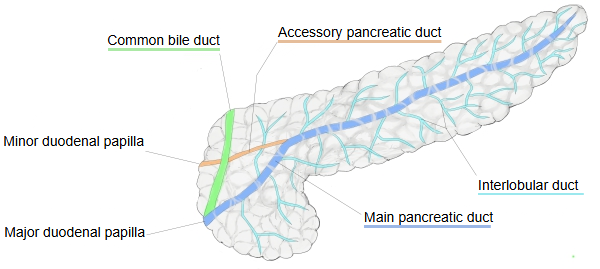
- Main pancreatic duct : the main channel for pancreatic juice; about 15–20 cm long in adults. = duct of Wirsung
- Accessory pancreatic duct : a smaller duct that is not open in everyone (sources differ on how often); a few centimetres long. = duct of Santorini
 Ducts of the pancreas
 Main pancreatic duct and bile ducts
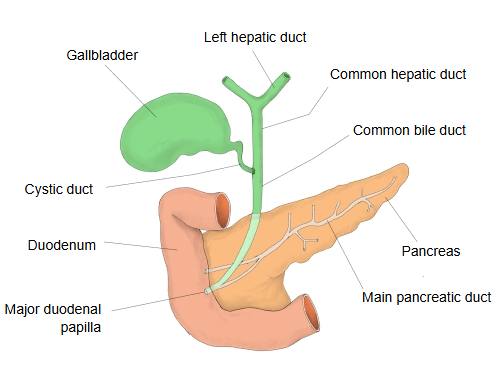
Main pancreatic duct
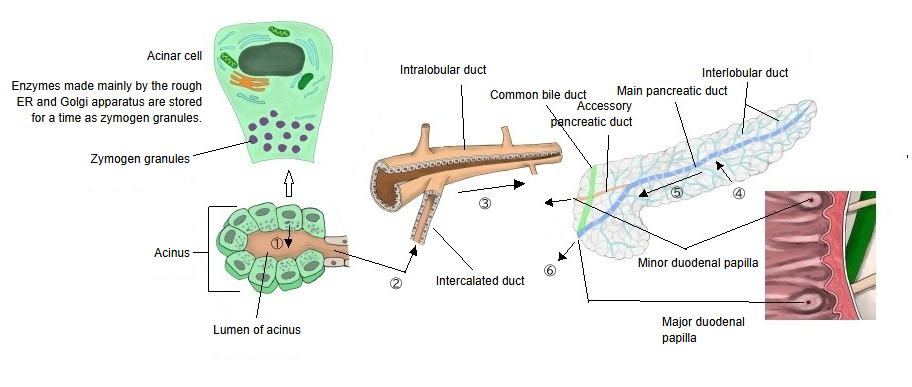
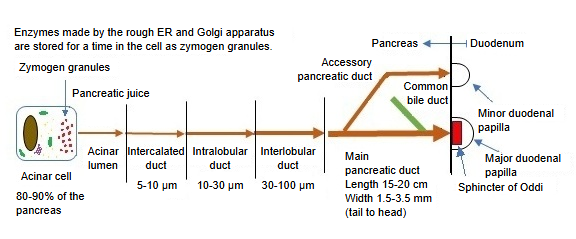
[Structure of the main pancreatic duct]
| Layer | Description | |
|---|---|---|
| 1 | Lumen | The channel through which pancreatic juice flows; normally a clear fluid. |
| 2 | Epithelium | A simple columnar epithelium lines the duct (cuboidal in the small ducts); some of its cells secrete mucus. |
| 3 | Connective tissue | Contains elastic fibres, connective tissue, blood vessels and nerves. |
| 4 | Muscle | No distinct muscle layer along most of the duct; near its opening the smooth muscle is well developed and forms part of the sphincter of Oddi (a sphincter), which controls the flow into the duodenum. |
[Width (inner diameter) of the main pancreatic duct]
It is widest in the head and narrows towards the tail: in adults about 2.5–3.5 mm in the head (normally about 3 mm or less), about 2–2.5 mm in the body and about 1.5–2 mm in the tail.
It tends to widen a little with age; in older people a width of more than 3 mm can be normal.
Accessory pancreatic duct
[Length of the accessory pancreatic duct]
Its length varies greatly between people, so no single figure can be given.
It is a short duct, usually a few centimetres long, running from the head of the pancreas to the minor duodenal papilla.
The two ducts come from the two buds that form the pancreas in the embryo. When they fail to join (pancreas divisum), most of the gland drains through the accessory duct.
Reference websites
[Wikipedia]
· Pancreatic duct, Wikipedia.
· Accessory pancreatic duct, Wikipedia.
[Websites with illustrations]
· Pancreatic duct, bile duct and major duodenal papilla (figure) (TeachMeAnatomy)
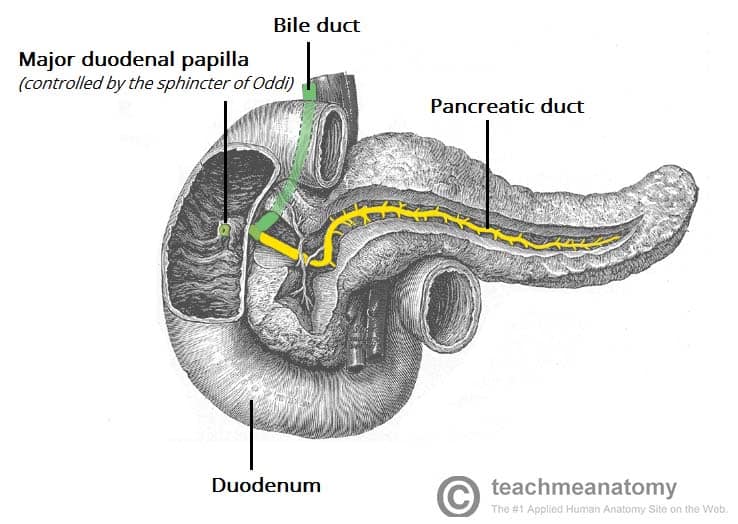
· Model of the pancreatic ducts (figure) (Lecturio)
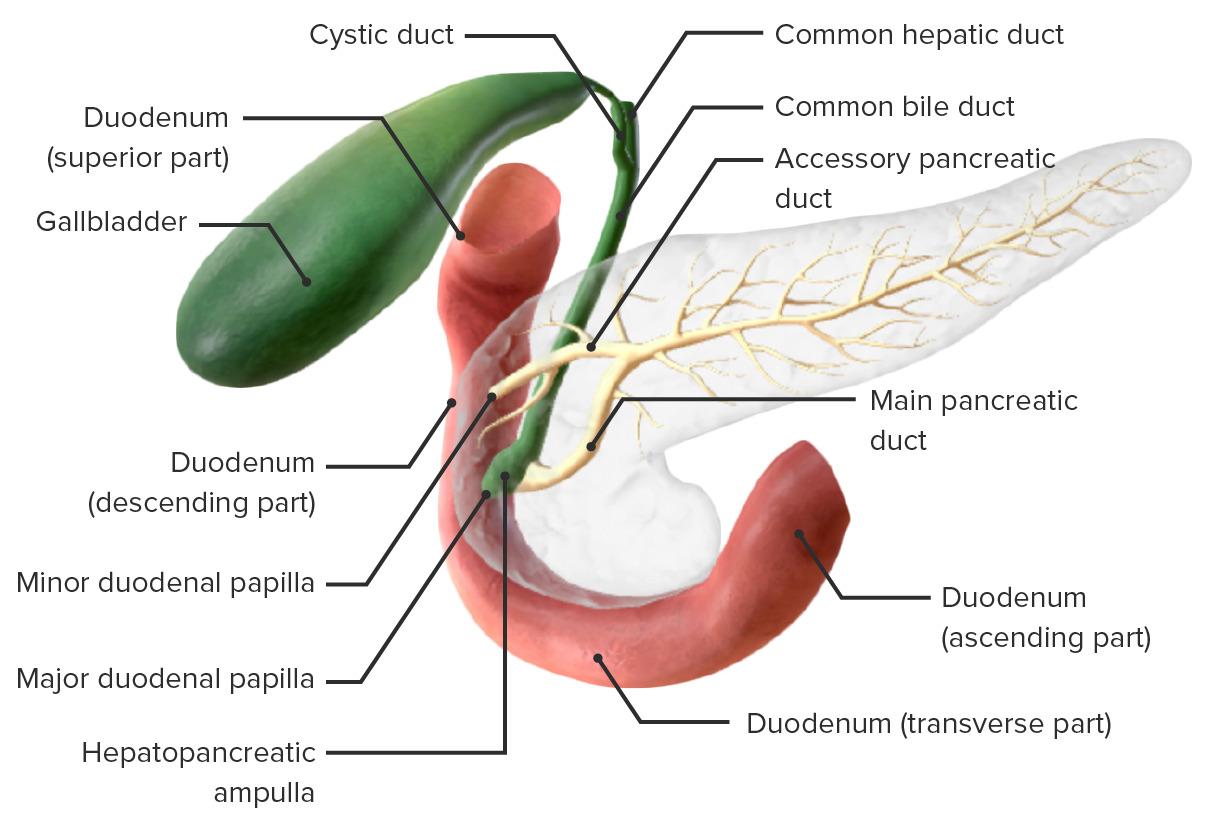
· Hepatopancreatic ampulla area (figure) (AnatomyTOOL)

· Accessory pancreatic duct (Radiopaedia)
Where it is found
Related terms
- Pancreas
- Accessory pancreatic duct
- Common bile duct
- Sphincter of Oddi
- Duodenum
- Acinar cells
- Centroacinar cells
References and sources
- Further reading: Pancreatic duct, Wikipedia.
- Further reading: Accessory pancreatic duct, Wikipedia.
- Federative International Programme for Anatomical Terminology (FIPAT). Terminologia Anatomica, 2nd ed. (TA2), 2019.