Lateral palpebral commissure (Latin: commissura lateralis palpebrarum)
Also called the lateral canthus (in clinical use)
The lateral palpebral commissure is the place where the upper eyelid and the lower eyelid meet at the outer side: the outer corner of the eye.
The upper and lower eyelids
It is not just a meeting of skin: inside it, a strong fibrous band, the lateral palpebral ligament, holds it in place.
 Eyelids and palpebral commissures
 Ligaments of the eyelids
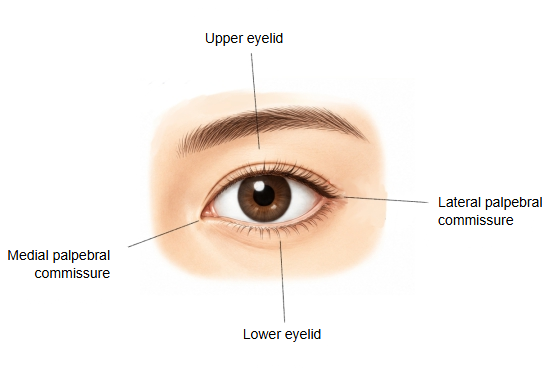
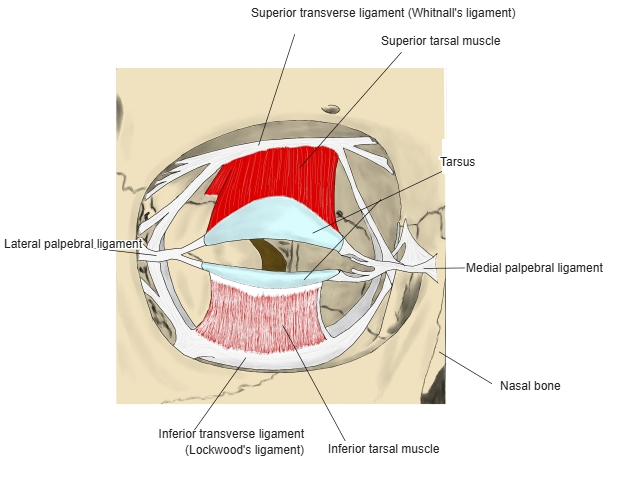
· It forms the lateral angle of the eye, the outer end of the palpebral fissure. The matching junction at the inner corner is the medial palpebral commissure.
· Deep to it, the tarsal plates of both lids are held to the orbital margin by the lateral palpebral ligament, which attaches to the zygomatic bone just inside the orbital rim. The lateral angle is sharper than the medial angle and lies in close contact with the eyeball.
Related terms
- Eyelids
- Lateral palpebral ligament
- Medial palpebral ligament
- Orbicularis oculi
- Zygomatic bone
- Lateral palpebral arteries
References and sources
- Further reading: Canthus, Wikipedia.
- Federative International Programme for Anatomical Terminology (FIPAT). Terminologia Anatomica, 2nd ed. (TA2), 2019.