Lateral semicircular duct (Latin: ductus semicircularis lateralis)
Also called the horizontal semicircular duct
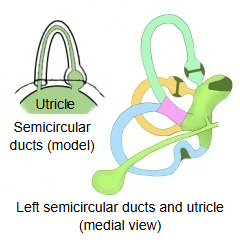
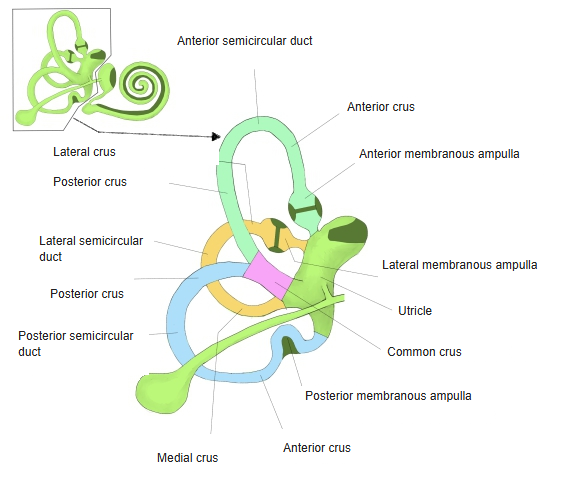
The lateral semicircular duct is one of the three semicircular ducts and lies furthest out (most laterally) of the three.
It lies inside the lateral (bony) semicircular canal and fills only about a quarter to a third of its width; it is part of the membranous labyrinth
The lateral duct lies almost horizontally, so its outer end is called the lateral limb and its inner end the medial limb.
The lateral limb is the one that bears the ampullaSources differ in what they call the two ends: anterior and posterior, or lateral and medial
The lateral limb forms the lateral membranous ampulla before it opens into the utricle; the medial limb opens into the utricle on its own.
Utricle: one of the two sacs in the middle of the membranous labyrinth
The duct senses rotation of the head in the horizontal plane, mainly turning the head from side to side. With the head upright its plane is close to horizontal, tilted up at the front by about 30 degrees. It is the shortest of the three ducts. The rest of the bony canal around it is perilymphatic space, and the duct itself contains endolymph. Its ampulla lies next to the anterior membranous ampulla, and the ampullary crest in it is supplied by the lateral ampullary nerve, a branch of the superior part of the vestibular nerve. Unlike the anterior and posterior ducts, it does not take part in the common membranous limb.
- Anterior duct : = superior duct. Lies highest. Has two limbs: the ampullary (anterior) limb forms the anterior membranous ampulla just before it opens into the utricle; the simple (posterior) limb joins that of the posterior duct to form the common crus. Top
- Lateral duct : Lies furthest out (laterally). Has two limbs: the ampullary (lateral) limb forms the lateral membranous ampulla just before it opens into the utricle; the simple (medial) limb opens into the utricle on its own.
- Posterior duct : Lies lowest. Has two limbs: the ampullary (lower) limb forms the posterior membranous ampulla just before it opens into the utricle; the simple (upper) limb joins that of the anterior duct to form the common crus. Bottom
- All three : filled with endolymph; held to the bony semicircular canals by connective tissue strands.
- Anterior duct : ampullary limb → anterior membranous ampulla → utricle; simple limb → membranous common crus → utricle.
- Lateral duct : ampullary limb → lateral membranous ampulla → utricle; simple limb → directly into the utricle.
- Posterior duct : ampullary limb → posterior membranous ampulla → utricle; simple limb → membranous common crus (with the anterior duct) → utricle.
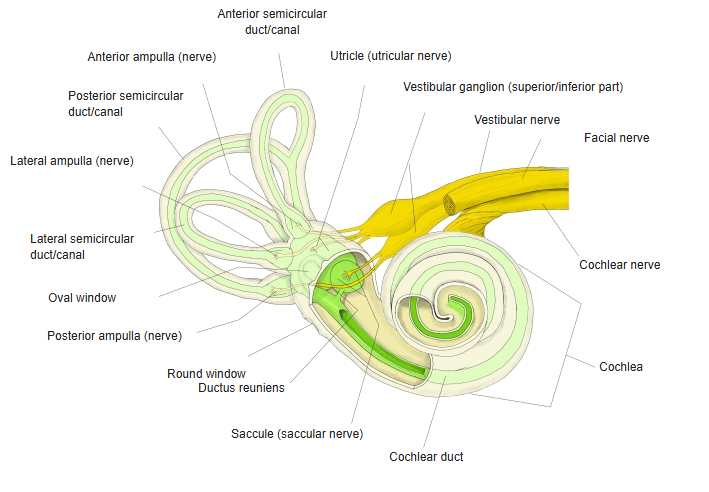
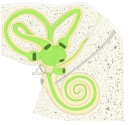 Bony and membranous labyrinth
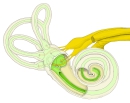 Labyrinth and nerves
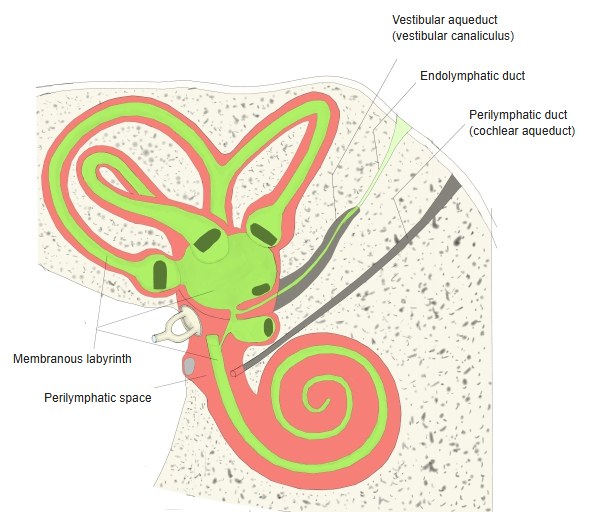
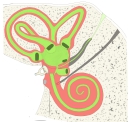 Perilymphatic space and membranous labyrinth
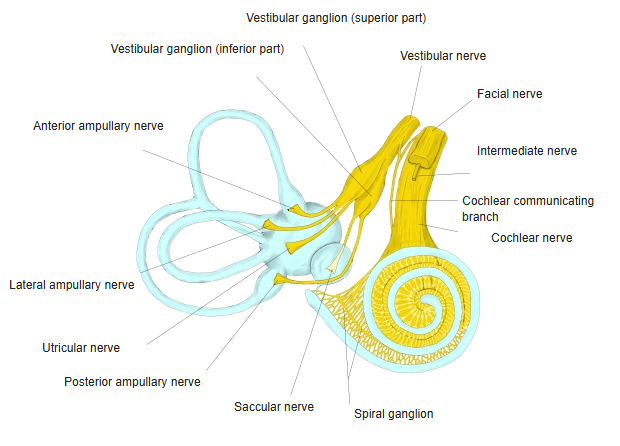
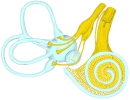 Membranous labyrinth and nerves
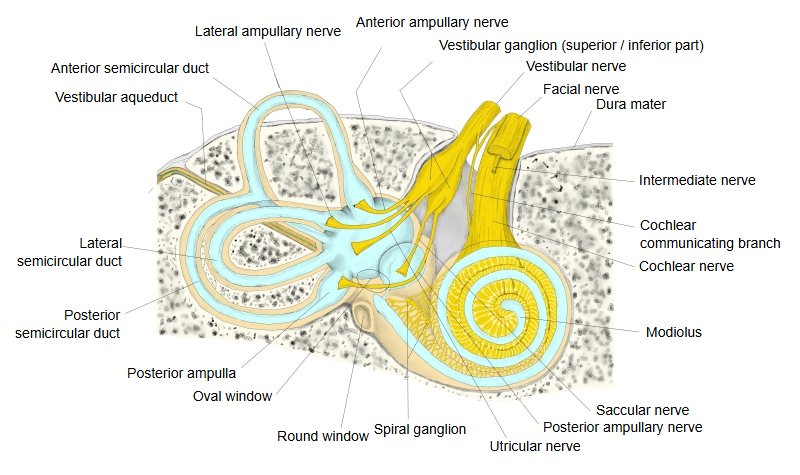
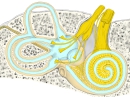 Labyrinth and nerves (detail)
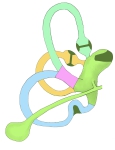 The three semicircular ducts
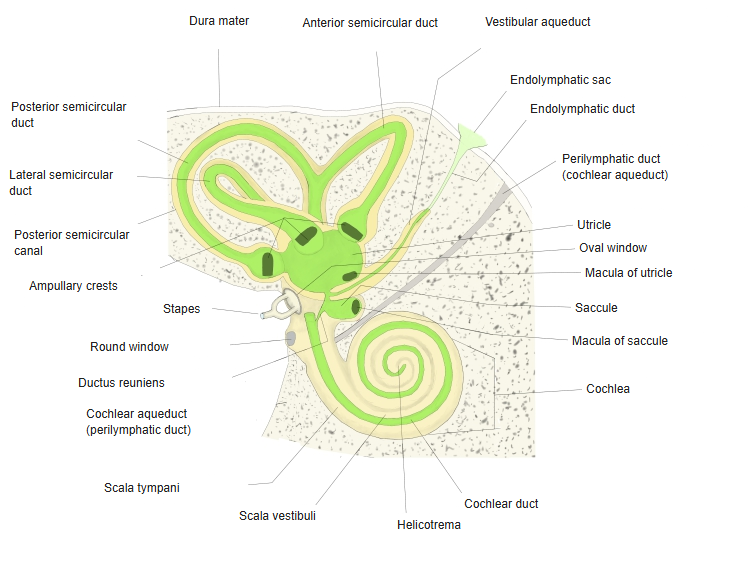
Related terms
- Semicircular ducts
- Semicircular canals
- Membranous labyrinth
- Lateral semicircular canal
- Utricle
- Lateral ampullary nerve
- Vestibular nerve
References and sources
- Further reading: Semicircular canals, Wikipedia.
- Further reading: Membranous labyrinth, Wikipedia.
- Federative International Programme for Anatomical Terminology (FIPAT). Terminologia Anatomica, 2nd ed. (TA2), 2019.