Joint socket (Latin: fossa articularis)
Also called the articular fossa
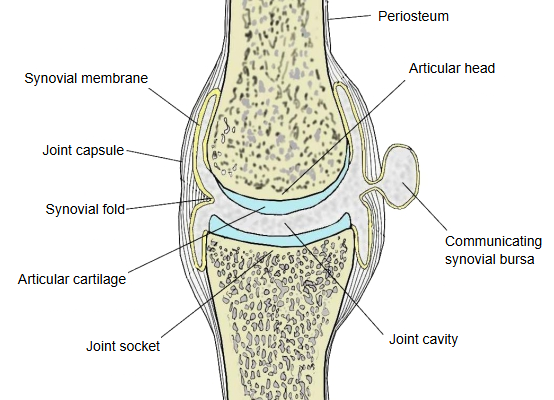
The joint socket is the surface of a joint that is concave and receives the other bone; it is the concave articular surface of a synovial joint.
The other, convex surface that fits into the joint socket is called the articular head
Most synovial joints pair a convex articular head with a concave socket; both are covered with articular cartilage.
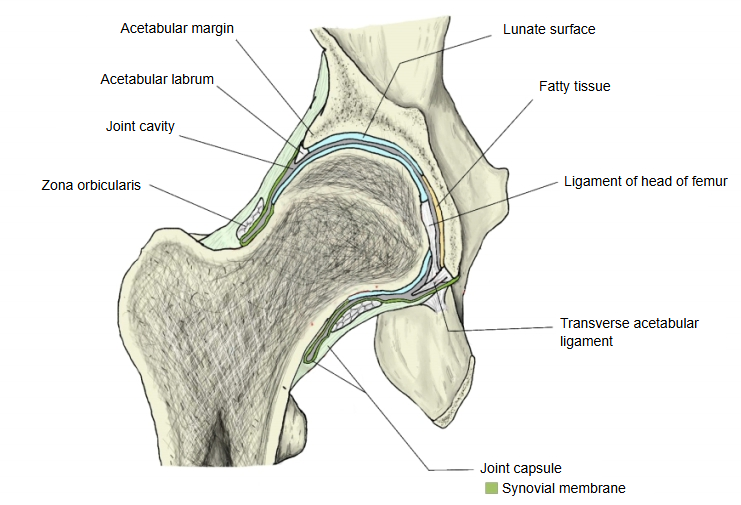
Its depth varies: the acetabulum of the hip joint is deep, while the glenoid cavity of the shoulder (glenohumeral) joint is shallow.
A deep socket gives stability; a shallow one allows a wider range of movement. A fibrocartilage labrum deepens the socket in both the hip (acetabular labrum) and the shoulder.
⇒ Main parts of a movable (synovial) joint
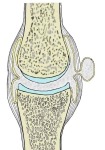 Synovial joint (schematic)
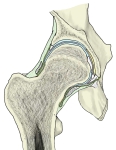 Hip joint (coronal section)
Related terms
References and sources
- Further reading: Synovial joint, Wikipedia.
- Federative International Programme for Anatomical Terminology (FIPAT). Terminologia Anatomica, 2nd ed. (TA2), 2019.