Posterior semicircular canal (Latin: canalis semicircularis posterior)
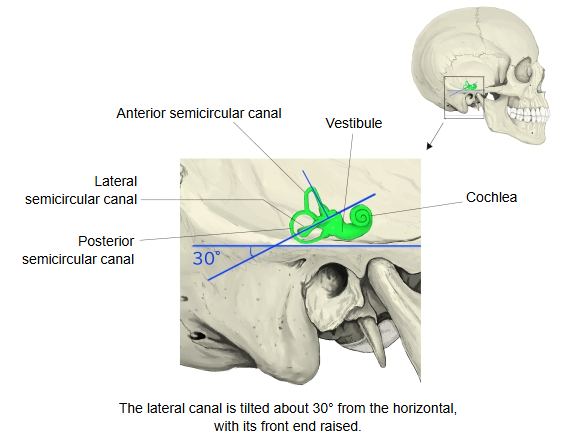
· Its curved plane is vertical and lies parallel to the long axis of the petrous part of the temporal bone, so it is set at about 45° to both the coronal and the sagittal plane.
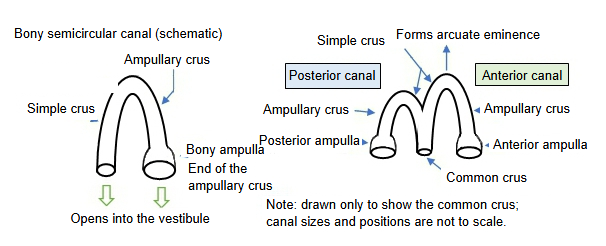
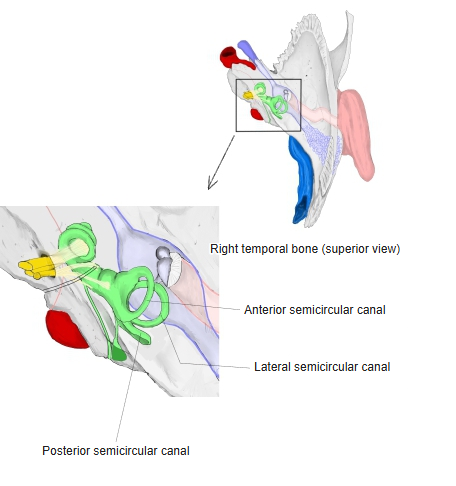
- Anterior (bony) semicircular canal : (= superior semicircular canal) the uppermost of the three. It stands vertically at right angles to the long axis of the petrous part (about 45° to the sagittal plane) and raises the arcuate eminence on the upper surface of the petrous part of the temporal bone. Its simple crus joins that of the posterior canal to form the (bony) common crus. End of the ampullary crus = anterior bony ampulla.length: about 15–20 mm
- Lateral (bony) semicircular canal : the shortest of the three and of middle width; it runs almost horizontally, backwards and laterally. Its bulge forms the prominence of the lateral semicircular canal on the medial wall of the tympanic cavity. End of the ampullary crus = lateral bony ampulla.length: about 12–15 mm
- Posterior (bony) semicircular canal : the lowest and longest of the three; it lies almost parallel to the long axis of the petrous part. Its simple crus joins that of the anterior canal to form the (bony) common crus. End of the ampullary crus = posterior bony ampulla.length: about 18–22 mm
- Anterior canal
- Simple crus : joins the simple crus of the posterior canal; as the (bony) common crus it opens into the medial wall of the back part of the vestibule.
- Ampullary crus → anterior bony ampulla : opens into the upper part of the vestibule, near the elliptical recess.
- Lateral canal
- Ampullary crus → lateral bony ampulla : opens into the vestibule just below the anterior ampulla, lateral to the elliptical recess.
- Simple crus : opens on its own into the back of the vestibule, between the common crus and the posterior ampulla.
- Posterior canal
- Simple crus : joins the simple crus of the anterior canal to form the common crus.
- Ampullary crus → posterior bony ampulla : opens into the lower back part of the vestibule.
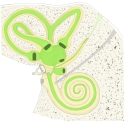 Bony and membranous labyrinth
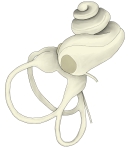 Bony labyrinth
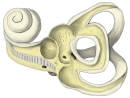 Bony labyrinth (opened)
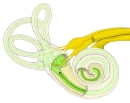 Labyrinth and nerves
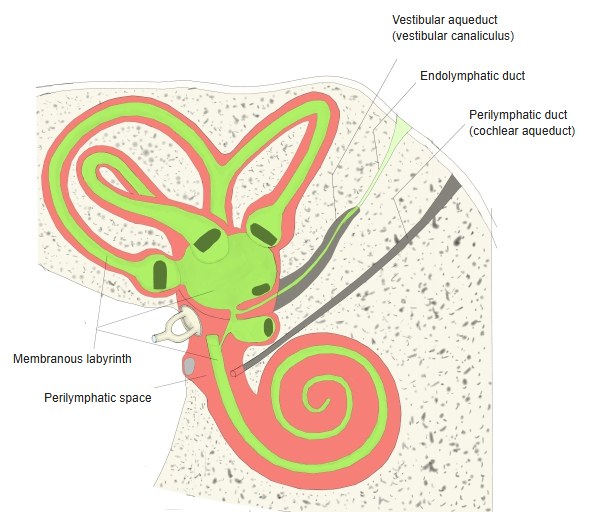
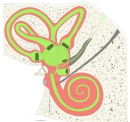 Perilymphatic space and membranous labyrinth
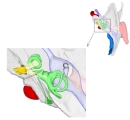 Right temporal bone from above
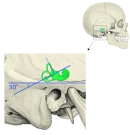 Position of the canals in the skull
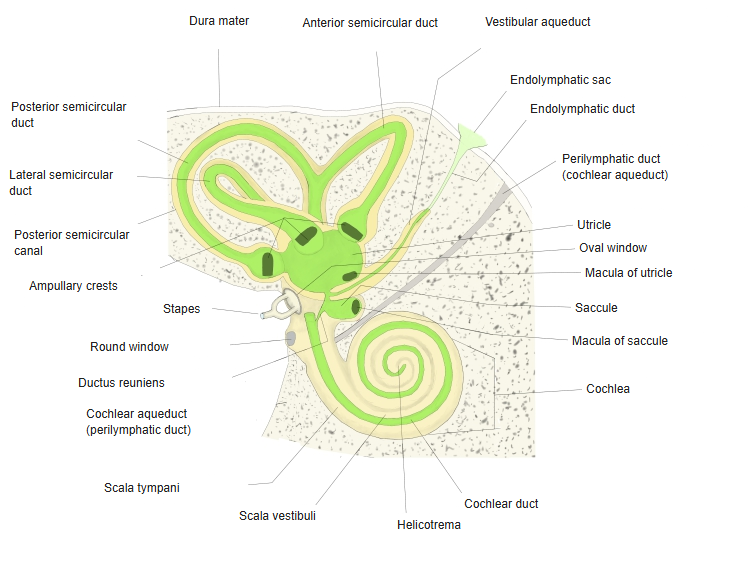
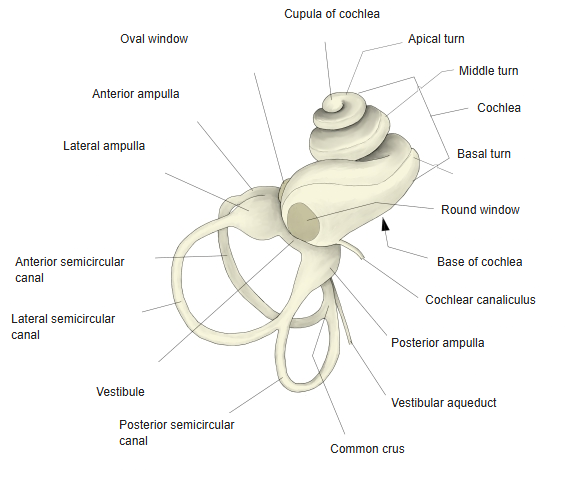
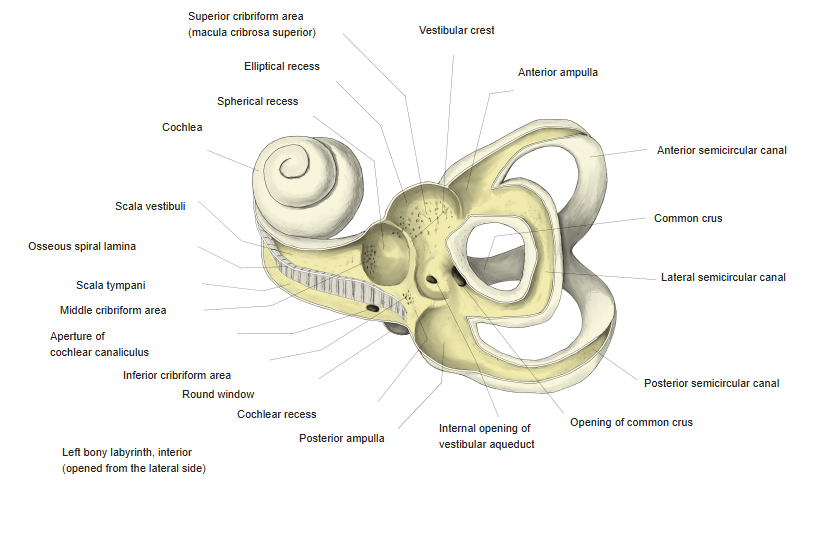
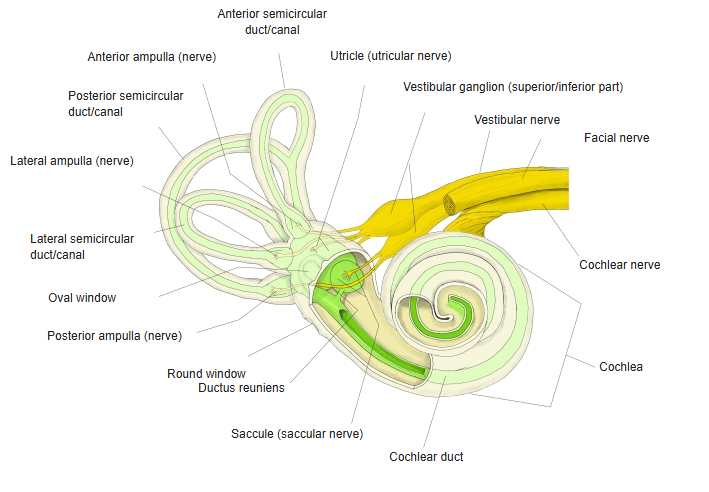
It is the longest, the most strongly curved and the widest of the three canals. Its ampullary end, the posterior bony ampulla, opens into the lower back part of the vestibule; its other end, the simple crus, joins the simple crus of the anterior canal to form the bony common crus.
· It lies near the posterior surface of the petrous part; the vestibular aqueduct lies just medial to it. It contains the posterior semicircular duct and senses rotation of the head in its own plane, working as a pair with the anterior canal of the other side. The sensory crest in its ampulla is supplied by the posterior ampullary nerve. The third canal is the lateral semicircular canal.
Reference websites
[Wikipedia]
· Semicircular canals, Wikipedia.
· Bony labyrinth, Wikipedia.
[Websites with illustrations]
· The inner ear: bony labyrinth and membranous labyrinth (TeachMeAnatomy)
· Internal ear anatomy: cochlea, vestibule and canals (Kenhub)
· Right osseous labyrinth, lateral view (Gray's Anatomy) (Wikimedia Commons)

Related terms
- Semicircular canals
- Semicircular ducts
- Lateral semicircular canal
- Bony labyrinth
- Vestibule
- Posterior ampullary nerve
- Petrous part
References and sources
- Further reading: Semicircular canals, Wikipedia.
- Further reading: Bony labyrinth, Wikipedia.
- Federative International Programme for Anatomical Terminology (FIPAT). Terminologia Anatomica, 2nd ed. (TA2), 2019.