Uncinate process of cervical vertebra (Latin: uncus corporis vertebrae cervicalis)
Also called the uncus of body
It is also called the uncus of the vertebral body.
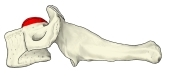 7th cervical vertebra (left side)
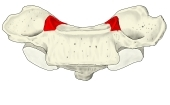 7th cervical vertebra (anterior view)
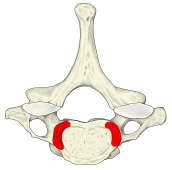 7th cervical vertebra (superior view)
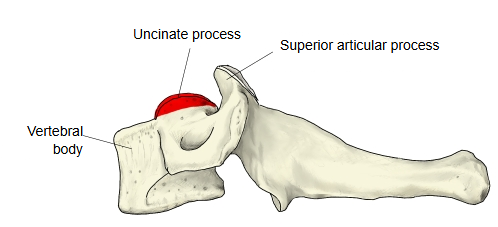
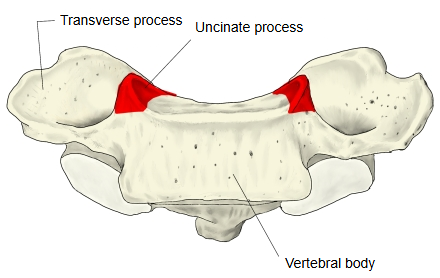
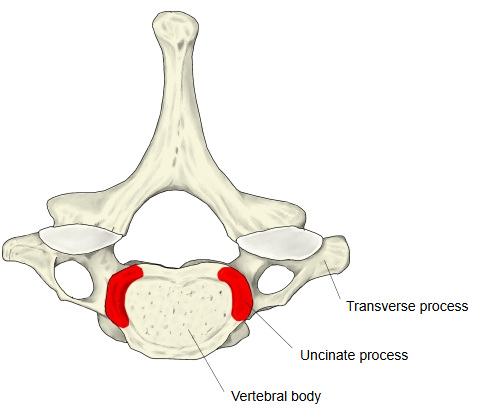
The uncinate processes are hook-like projections on each side of the upper surface of the bodies of the third to seventh cervical vertebrae. They turn up the lateral edges of the vertebral body, so its upper surface is hollowed from side to side. Each fits against a bevelled notch on the lower lateral edge of the vertebral body above; this small contact is the uncovertebral joint (joint of Luschka). They help to stop the vertebrae sliding sideways on each other and guide flexion and extension of the neck.
They lie just in front of the intervertebral foramen and medial to the vertebral artery. Bony spurs (osteophytes) often grow here with age (uncovertebral spondylosis) and can narrow the foramen and press on a spinal nerve root.
Similar processes are often seen on both sides of the body of the first thoracic vertebra, as on the cervical vertebrae.
Reference websites
[Wikipedia]
· Uncinate process of vertebra, Wikipedia.
· Uncovertebral joint (Luschka's joints), Wikipedia.
[Websites with illustrations]
· The cervical spine (TeachMeAnatomy)
Related terms
- Cervical vertebrae
- Vertebral body
- Transverse process
- Superior articular process
- Vertebral artery
- Uncinate process
References and sources
- Further reading: Uncinate process of vertebra, Wikipedia.
- Further reading: Uncovertebral joint, Wikipedia.
- Federative International Programme for Anatomical Terminology (FIPAT). Terminologia Anatomica, 2nd ed. (TA2), 2019.