Uncinate process (Latin: processus uncinatus ossis ethmoidalis)
Also called the uncinate process of ethmoid bone
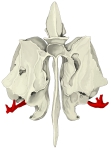 Ethmoid bone (posterior view)
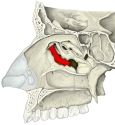 Lateral wall of nasal cavity
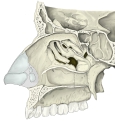 Lateral wall of nasal cavity (labelled)
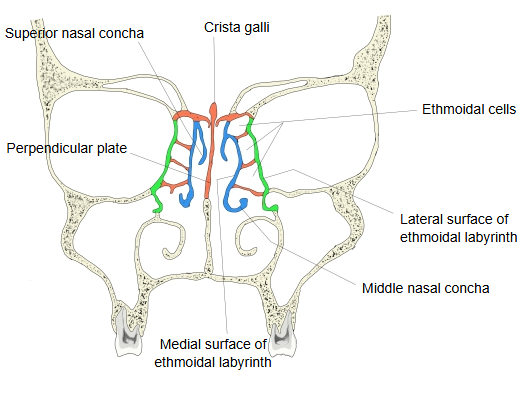
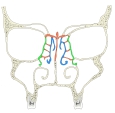 Coronal section through the orbits
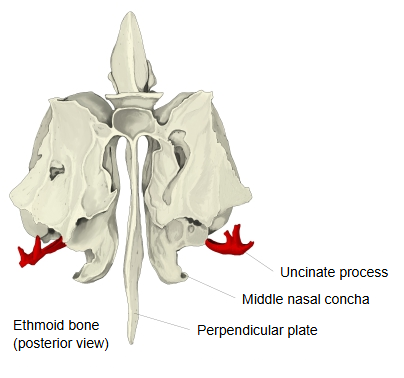
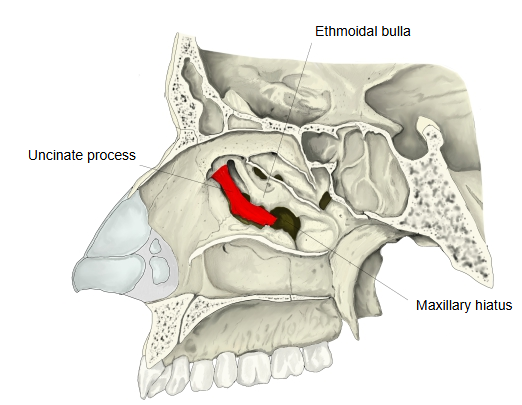
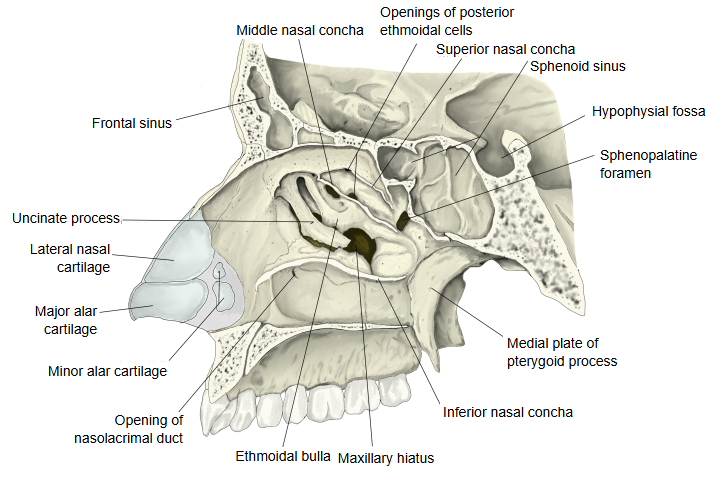
It is a long, slender plate of bone that runs down and back from the front ethmoidal cells, in front of and partly medial to the ethmoidal bulla, hidden under the middle nasal concha on the lateral wall of the nasal cavity. Its lower end meets the ethmoidal process of the inferior nasal concha. Lying across the maxillary hiatus, it leaves the maxillary sinus a much smaller opening into the nose.
Semilunar hiatus and ethmoidal infundibulum
Between the free back edge of the uncinate process and the front of the ethmoidal bulla is a curved slit, the semilunar hiatus. It leads sideways into a narrow channel, the ethmoidal infundibulum, bounded by the uncinate process medially, the orbital plate (lamina papyracea) laterally and the ethmoidal bulla behind and above. The opening of the maxillary sinus lies in this channel, which opens into the middle nasal meatus.
Variations
The upper end of the uncinate process is attached in different people to the orbital plate (lateral nasal wall), to the roof of the ethmoid at the skull base, or to the middle concha. This decides how the frontal sinus drains: when it is attached to the orbital plate, the frontal recess is separated from the infundibulum and the frontal sinus drains straight into the middle meatus; in the other cases it drains first into the infundibulum.
Note: this page covers the uncinate process of the ethmoid bone. The same name is also used for the raised side lips on the upper surface of the bodies of the 3rd–7th cervical vertebrae (uncus of body, which forms the uncovertebral joints) and for part of the pancreas.
Reference websites
[Wikipedia]
· Uncinate process of ethmoid bone, Wikipedia.
· Ethmoid bone, Wikipedia.
· Ethmoidal infundibulum, Wikipedia.
[Websites with illustrations]
· Ethmoid bone (Kenhub)
· The Nasal Cavity (TeachMeAnatomy)
Where it is found
Related terms
- Ethmoid bone
- Ethmoidal labyrinth
- Ethmoidal bulla
- Ethmoidal air cells
- Middle nasal concha
- Middle nasal meatus
- Maxillary hiatus
- Maxillary sinus
References and sources
- Further reading: Uncinate process of ethmoid bone, Wikipedia.
- Further reading: Ethmoid bone, Wikipedia.
- Federative International Programme for Anatomical Terminology (FIPAT). Terminologia Anatomica, 2nd ed. (TA2), 2019.