Cambium layer (Latin: stratum osteogenicum periostei)
Also called the osteogenic layer or the inner layer of the periosteum
The cambium layer of the periosteum is
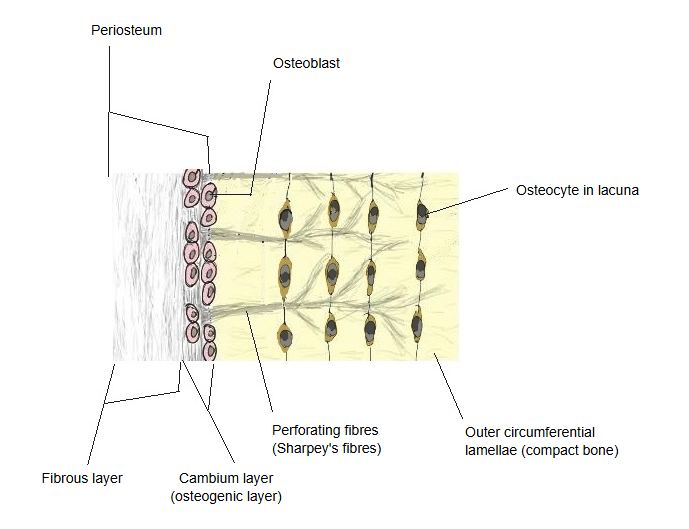
- Fibrous layer (outer layer) : stratum fibrosum: made of bundles of connective tissue and elastic fibres.
- Cambium layer (inner layer) : stratum osteogenicum: contains osteoblasts; also called the cell layer or proliferative layer.
The inner layer is softer than the outer layer, with finer collagen bundles, and is rich in elastic fibres. It contains many cells (osteoprogenitor cells and osteoblasts), which sometimes form dense groups.
In adults the cambium layer may contain osteoclasts as well as osteoblasts. It is thick and active in growing children and becomes thin and less active in adults.
It lays down new bone on the surface, so it lets a bone grow in thickness. Continuing this early role in bone formation from the periosteum, it plays the most important part when bone is regenerated after an injury or a defect, such as in the healing of a fracture.
Reference websites
[Wikipedia]
· Periosteum, Wikipedia.
· Osteoblast, Wikipedia.
[Websites with illustrations]
· Periosteum and endosteum (Wikimedia Commons)

Related terms
- Diaphysis
- Epiphysis
- Epiphyseal cartilage
- Periosteum
- Endosteum
- Bone marrow
- Bone matrix
- Osteoclast
- Articular cartilage
- Nutrient foramen
- Nutrient canal
- Flat bone
References and sources
- Further reading: Periosteum, Wikipedia.
- Further reading: Osteoblast, Wikipedia.
- Federative International Programme for Anatomical Terminology (FIPAT). Terminologia Anatomica, 2nd ed. (TA2), 2019.