Flat bone (Latin: os planum)
of bones
by shape
- Long bone : a bone that is longer than it is wide, whatever its size, such as the femur and the humerus. Also called a tubular bone.
- Short bone : about as long as it is wide, such as the carpal bones and tarsal bones.
- Flat bone : a thin, plate-like bone, such as the bones of the skull roof and the sternum.
- Irregular bone : a bone of irregular shape, such as the vertebrae and many bones of the facial skeleton.
- Pneumatic bone : a bone containing air-filled spaces, such as the frontal bone and the sphenoid bone.
- Sesamoid bone : a small bone that forms within a tendon, or in an articular capsule fused with a tendon, mainly in the hand and foot.
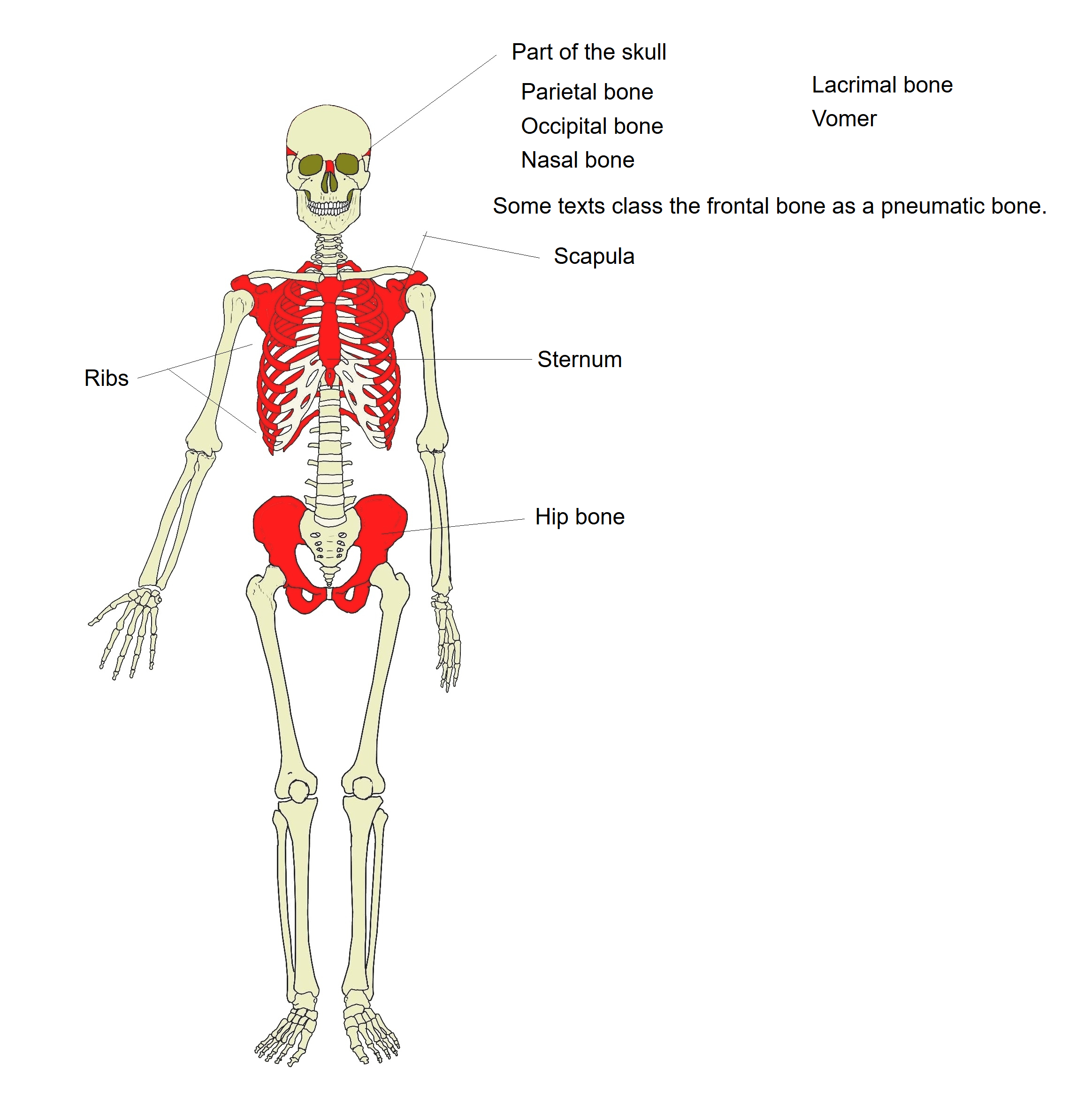
A flat bone is a thin, flattened bone: a thin layer of spongy bone lies between two firm plates of compact bone. In the skull roof these are the outer and inner tables, and the spongy layer between them is called the diploë. Besides the bones of the skull, the sternum, the ribs, the scapula and the ilium (part of the hip bone) are flat bones. Flat bones such as the frontal bone and the parietal bone, which form the calvaria, enclose and protect a cavity, and their broad surfaces also give attachment to muscles.
Flat bones keep red bone marrow in adults, so they are important sites of blood cell formation. Sources differ on some bones: the frontal bone is a flat bone in most English texts, but some class it as a pneumatic bone because it contains the frontal sinus.
Reference websites
[Wikipedia]
· Flat bone, Wikipedia.
· Bone: types, Wikipedia.
[Websites with illustrations]
· Flat bones of the skeleton (anterior view, with legend) (Wikimedia Commons)

· Anatomy of a flat bone (OpenStax) (Wikimedia Commons)

Related terms
References and sources
- Further reading: Flat bone, Wikipedia.
- Further reading: Bone (types), Wikipedia.
- Federative International Programme for Anatomical Terminology (FIPAT). Terminologia Anatomica, 2nd ed. (TA2), 2019.