Right sagittal fossa (Latin: fossa sagittalis dextra)
Also called the right sagittal fissure or the right longitudinal fissure of liver
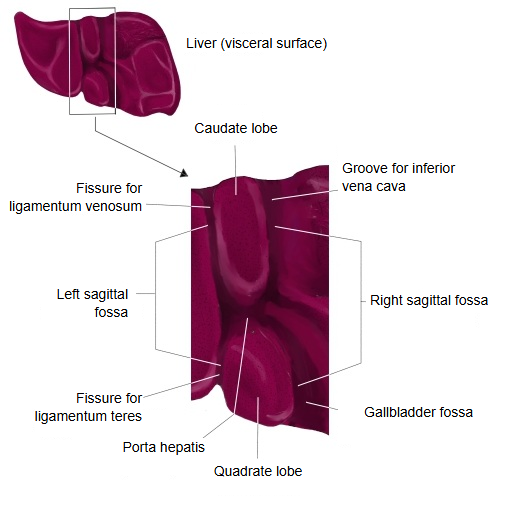
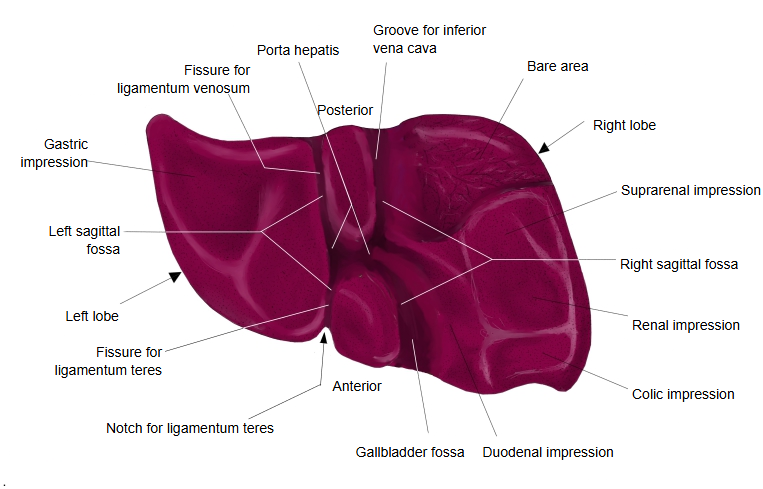
The right sagittal fossa is the hollow that runs from front to back on the visceral surface (lower surface) of the liver, to the right of the porta hepatis.
Porta hepatis: the entry and exit of the vessels and nerves, between the caudate lobe and the quadrate lobe
· The name is not a Terminologia Anatomica term and is missing from some anatomy references; current texts usually describe its two parts, the gallbladder fossa and the groove for vena cava, separately.
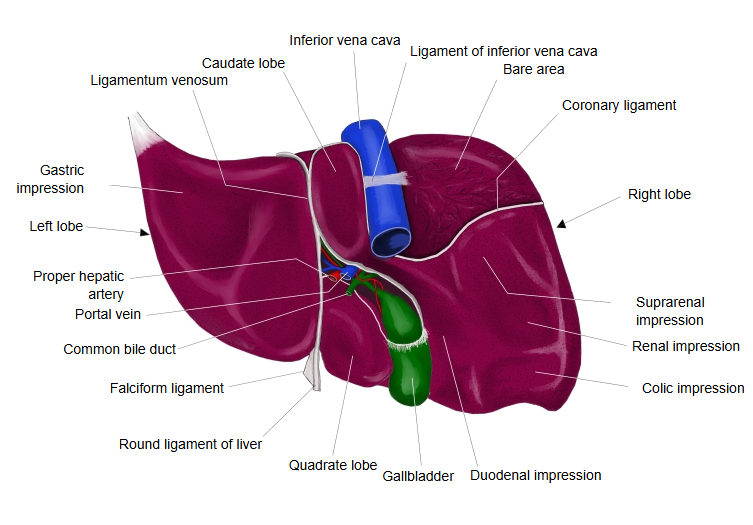
The front part of the right sagittal fossa is the gallbladder fossa, which holds the gallbladder; the back part is the groove for vena cava, which holds the inferior vena cava.
· With the left sagittal fossa, and the porta hepatis as the crossbar, it forms the H-shaped pattern of the visceral surface.
· It separates the right lobe from the quadrate lobe in front and the caudate lobe behind.
· A line through the gallbladder fossa and the groove for the inferior vena cava (Cantlie's line) marks the border between the functional left and right halves of the liver.
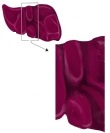 Left and right sagittal fossae
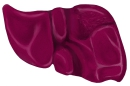 Liver (visceral surface)
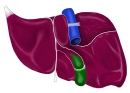 Liver (visceral surface)
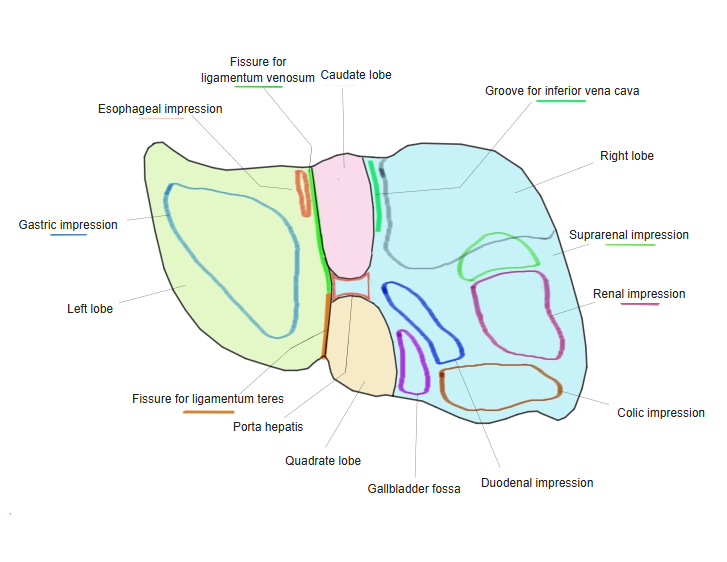
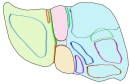 Features of the visceral surface
Related terms
- Left sagittal fossa
- Groove for vena cava
- Porta hepatis
- Quadrate lobe
- Caudate lobe
- Right lobe of liver
- Gallbladder
References and sources
- Further reading: Liver, Wikipedia.
- Further reading: Gallbladder, Wikipedia.
- Federative International Programme for Anatomical Terminology (FIPAT). Terminologia Anatomica, 2nd ed. (TA2), 2019.