Ciliary folds (Latin: plicae ciliares)
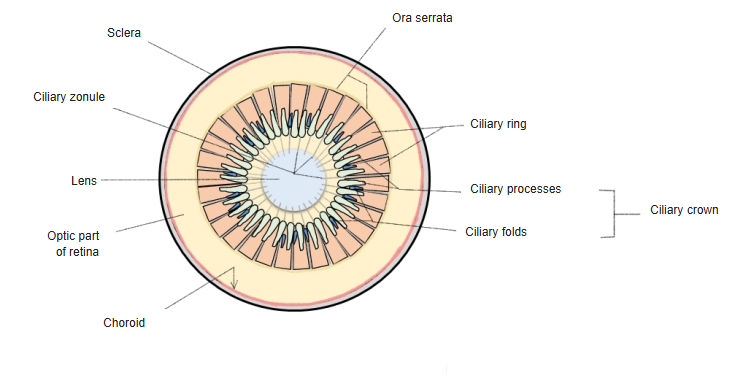
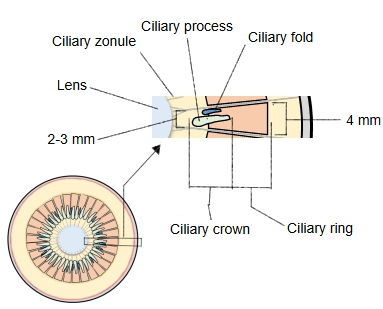
- Ciliary crown (front)
- Ciliary processes : about 70 radial folds (sources give from about 60 to 90) rich in capillaries; they produce the aqueous humor.
- Ciliary folds : low folds between the ciliary processes.
- Ciliary ring (back) : a band about 4 mm wide that meets the ora serrata; many fine ridges run on its inner surface.
· The ciliary folds are low folds on the ciliary crown of the ciliary body, lying in the valleys between the ciliary processes. They are much lower than the processes.
· Together with the ciliary folds lying between them, the ciliary processes give the crown its pleated, crown-like look when it is seen from inside the eye.
Some textbooks call the ciliary processes the "major processes" and the ciliary folds the "minor processes" (processus minores); others count the folds as part of the processes.
In one such description, the major processes are folds about 2–3 mm long, 0.12 mm wide and 0.8–1 mm high, highest where they face the edge of the lens. In the low spaces between them lie low, fine folds (the minor processes) that continue the ridges of the ciliary ring. The tips of the major processes do not touch the edge of the lens: even in the living eye they stay about 0.5 mm away from it.
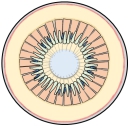 Ciliary body seen from inside
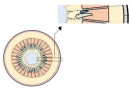 Ciliary crown and ciliary ring (enlarged)
Reference websites
[Wikipedia]
· Ciliary body, Wikipedia.
[Websites with illustrations]
· Structure of the ciliary body (figure) (BrainKart)

· Ciliary body, processes and zonule (figure) (The Free Dictionary (medical))

Related terms
- Ciliary crown
- Ciliary ring
- Ciliary processes
- Ciliary zonule
- Ciliary margin of iris
- Circular fibres of ciliary muscle
- Ciliary body
- Ora serrata
- Lens
- Aqueous humor
- Vascular layer of eyeball
References and sources
- Further reading: Ciliary body, Wikipedia.
- Federative International Programme for Anatomical Terminology (FIPAT). Terminologia Anatomica, 2nd ed. (TA2), 2019.