Philtrum (Latin: philtrum)
· Its free lower end bulges forward as the tubercle of upper lip.
- Skin part : like ordinary skin, with hair follicles, sweat glands and sebaceous glands; in men it carries the moustache and beard.
- Transition part : = transitional skin, between the skin part and the mucosal part ⇒ the part everyday language calls "the lips" (the red part, vermilion).
- Surface : covered by stratified squamous epithelium, very thin and non-keratinised or only thinly keratinised (sources differ); no hairs.
- Lamina propria : tall connective-tissue papillae rich in capillaries ⇒ the lips look red.
- Mucosal part : continuous with the oral mucosa (non-keratinised epithelium), with few papillae; contains the labial glands.
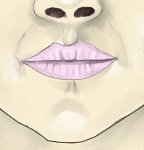 Lips
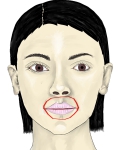 Anatomical lips
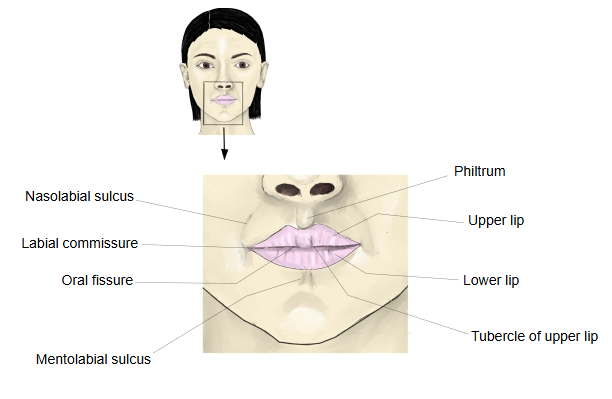
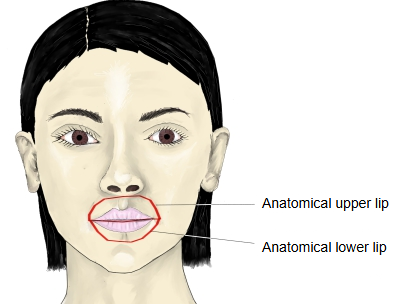
In more detail:
The upper lip has a broad, shallow vertical furrow in its middle, running from the base of the nasal septum down to the red part of the lip: this is the philtrum. On each side it is bounded by a low vertical ridge, the philtral column. At its lower end the red margin of the lip bulges forward as the tubercle of upper lip. The philtrum forms in the embryo where the two medial nasal processes meet in the midline; a cleft lip lies at the side of it.
Reference websites
[Wikipedia]
· Philtrum, Wikipedia.
[Websites with illustrations]
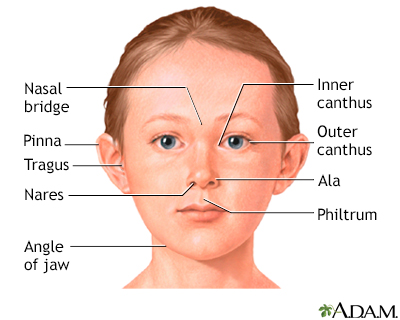
· Landmarks of the face, including the philtrum (A.D.A.M.)
· Surface of the face with the philtrum, nasolabial sulcus and lips (Sobotta, 1906) (Wikimedia Commons)

Related terms
References and sources
- Further reading: Philtrum, Wikipedia.
- Federative International Programme for Anatomical Terminology (FIPAT). Terminologia Anatomica, 2nd ed. (TA2), 2019.