Rotator cuff
Also called Musculotendinous cuff
The collective name for the supraspinatus, infraspinatus, teres minor and subscapularis, which join the scapula to the humerus and hold the glenohumeral (shoulder) joint together. Also called the musculotendinous cuff; the four muscles are often remembered as SITS.
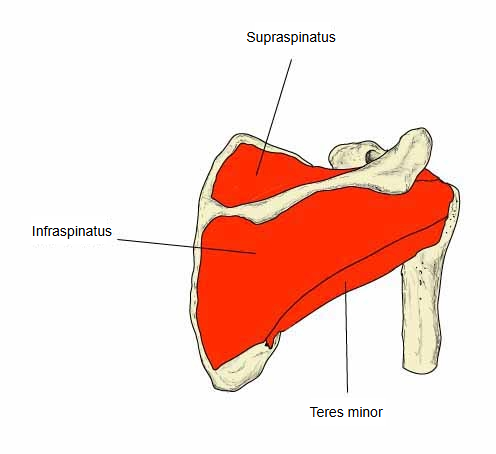
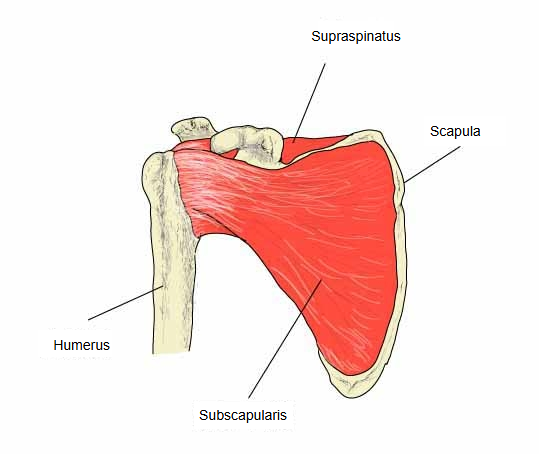
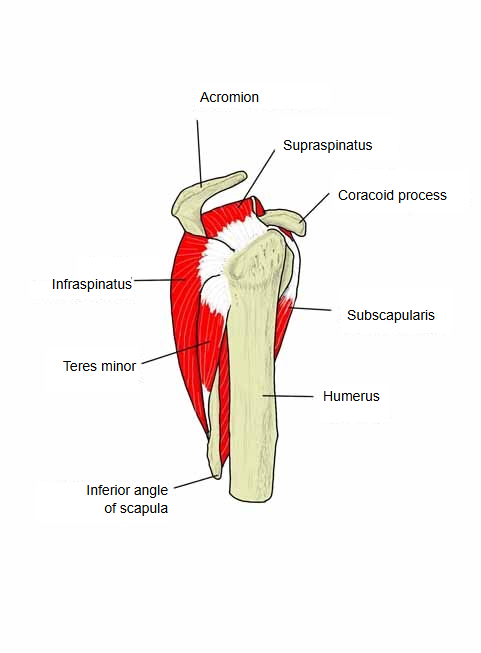
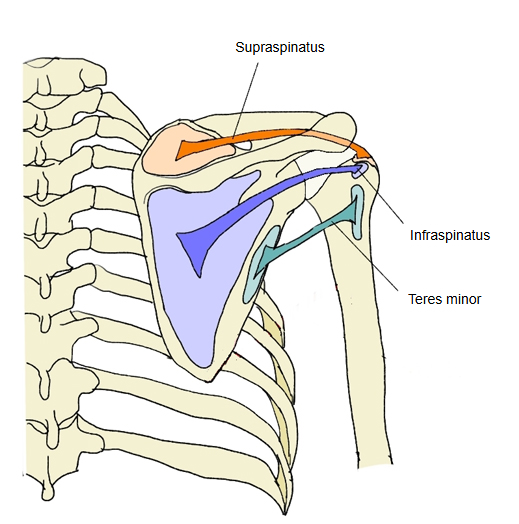
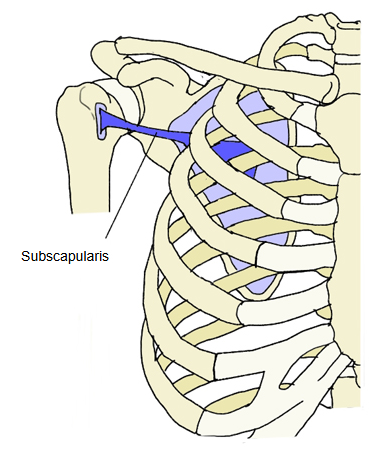
More detail: the muscle bellies and tendons of the supraspinatus, infraspinatus and teres minor, attached to the back of the scapula, and of the subscapularis on its front, are together called the rotator cuff. Part of the infraspinatus can be seen at the body surface, but the cuff muscles lie mostly deep, under the deltoid and trapezius. The shoulder joint has the widest range of movement of any joint in the body, but its socket is shallow, so it must be held firmly by muscles and ligaments; the rotator cuff plays this important role, keeping the head of the humerus pressed into the glenoid cavity during movement.
Supraspinatus, infraspinatus and teres minor arise from the back of the scapula and insert on the greater tubercle of the humerus; subscapularis arises from the front of the scapula and inserts on the lesser tubercle. Their tendons blend with the joint capsule and form a cuff over the top, back and front of the joint. The cuff is weakest below, where there is no cuff muscle.
 Model (posterior view)
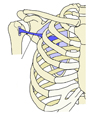 Model (anterior view)
Reference websites
[Wikipedia]
· Rotator cuff, Wikipedia.
[Websites with illustrations]
· Anatomy of the shoulder joint, back view (Wikimedia Commons)

· The human shoulder joint (Wikimedia Commons)

Related terms
- Supraspinatus
- Infraspinatus
- Teres minor
- Subscapularis
- Glenohumeral joint
- Greater tubercle
- Lesser tubercle
References and sources
- Further reading: Rotator cuff, Wikipedia.
- Federative International Programme for Anatomical Terminology (FIPAT). Terminologia Anatomica, 2nd ed. (TA2), 2019.