Median crest (cricoid cartilage)
Also called the median ridge of the cricoid lamina
· The hollows on either side of the median crest are called the fovea laminae; the posterior cricoarytenoid muscles arise from them. The upper part of the crest gives attachment to the crico-oesophageal tendon, which anchors the longitudinal muscle of the oesophagus.
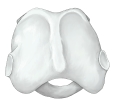 Cricoid cartilage (posterior view)
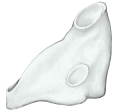 Cricoid cartilage (left lateral view)
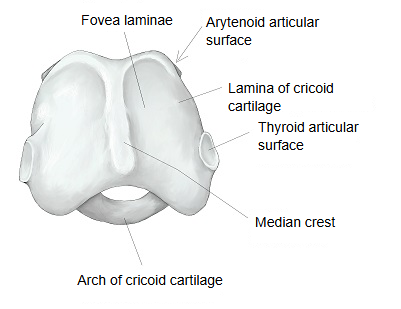
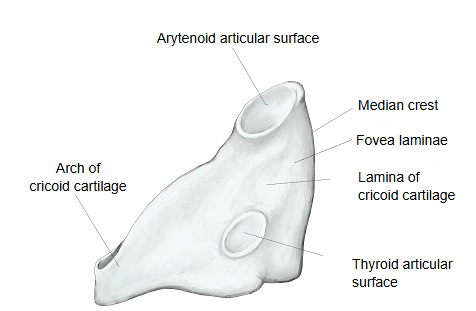
The cricoid cartilage as a whole:
It is made of hyaline cartilage and is unpaired. It lies below the thyroid cartilage, and below it is joined to the first tracheal cartilage by the cricotracheal ligament. It is shaped like a signet ring and becomes taller from front to back. The front part of the ring is curved and is called the arch of the cricoid cartilage; the back part widens into a square plate, the lamina. In the midline of the back of the lamina is a vertical ridge, the median crest. The hollows on each side are the fovea laminae, where the posterior cricoarytenoid arises. Where the lamina meets the arch there is a small round articular surface, the thyroid articular surface, which meets the cricoid articular surface of the inferior horn of the thyroid cartilage. The middle of the upper border of the lamina is slightly hollowed, and on each side of it is an oval articular surface, the arytenoid articular surface, which meets the arytenoid cartilage (see also the larynx).
Note: not to be confused with the median sacral crest on the back of the sacrum.
Related terms
- Vocal process
- Cricoid cartilage
- Lamina of cricoid cartilage
- Fovea laminae
- Arch of cricoid cartilage
- Cricoesophageal tendon
- Arytenoid articular surface
- Larynx
References and sources
- Further reading: Cricoid cartilage, Wikipedia.
- Federative International Programme for Anatomical Terminology (FIPAT). Terminologia Anatomica, 2nd ed. (TA2), 2019.