Cricoesophageal tendon (Latin: tendo cricooesophageus)
Also called the cricooesophageal tendon
A band of connective tissue that anchors the outer longitudinal muscle layer of the esophagus to the back of the cricoid cartilage of the larynx. It arises from the vertical midline ridge on the back of the lamina of the cricoid cartilage. From it the longitudinal fibres of the esophagus run down in two bundles that pass around the sides of the esophagus and meet again behind it, a few centimetres lower. Between these diverging bundles and the cricopharyngeus (the lowest part of the inferior pharyngeal constrictor of the pharynx), the back of the upper esophagus has a small V-shaped area covered mainly by circular muscle (Laimer's triangle). Because the esophagus is tied to the larynx here, it moves up with the larynx during swallowing. The outer longitudinal layer also sends small accessory slips to nearby structures in the thorax, such as the bronchoesophageal and pleuroesophageal muscles.
See the outer longitudinal muscle layer on the Esophagus page.
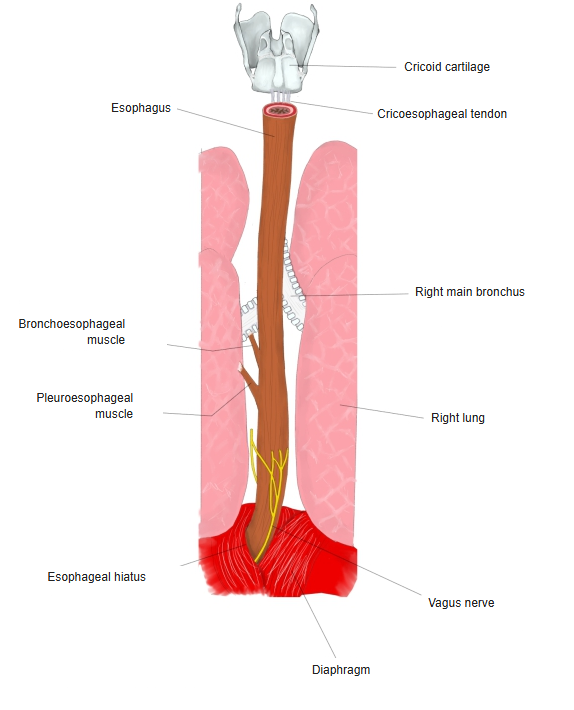
Where it is found
Related terms
References and sources
- Further reading: Esophagus, Wikipedia.
- Further reading: Cricoid cartilage, Wikipedia.
- Federative International Programme for Anatomical Terminology (FIPAT). Terminologia Anatomica, 2nd ed. (TA2), 2019.