Root of tooth (Latin: radix dentis)
Also called the dental root or the tooth root
- Overview
- Roots and root canals by tooth type
- Names of the roots
- Reference websites
- (Wikipedia, websites with illustrations)
- Related terms
Overview
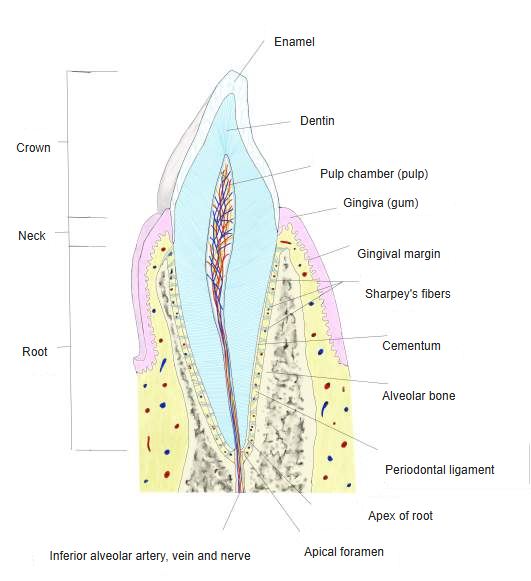
· The root is normally hidden by the gingiva and the alveolar process and cannot be seen in young people; with age the gum edge recedes, so part of the root is often exposed from middle age on. It is held in its socket by the periodontal ligament, whose fibres run from the cementum to the bone of the socket.
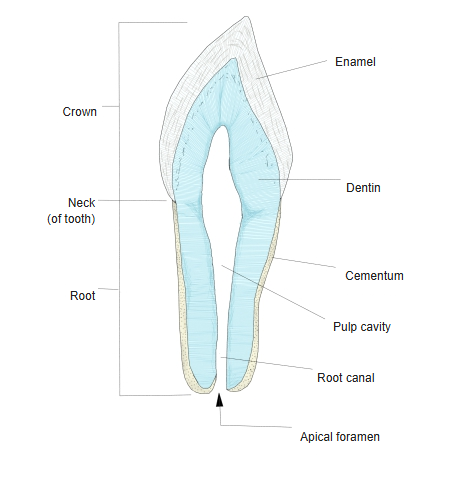
The root, too, is divided into an anatomical root and a clinical root. The anatomical root is the part covered with cementum, below the cementoenamel junction; the clinical root is the part hidden by the gingiva and the bone of the socket (alveolus) at a given time, and it gets shorter as the gum recedes. "Root" usually means the anatomical root.
of a tooth
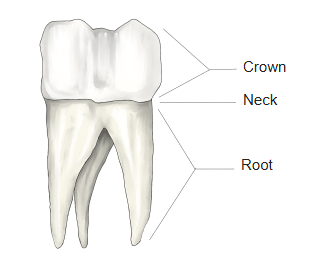
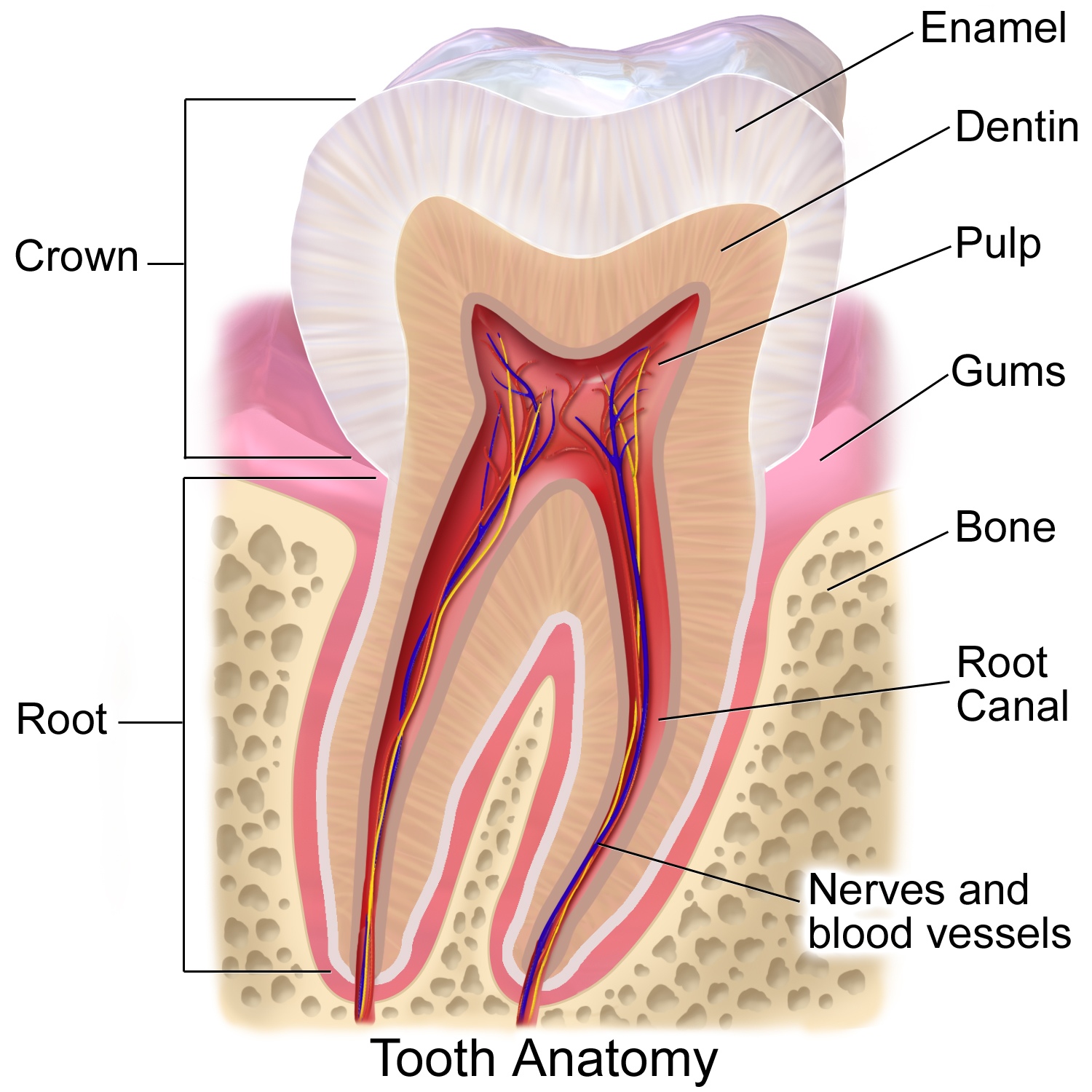
- Crown : the part that stands out of the gum and is covered with enamel
- Occlusal surface : where the upper and lower teeth meet; cusps and grooves on premolars and molars
- Vestibular surface : faces the oral vestibule; on premolars and molars it is the buccal surface
- Lingual surface : faces the oral cavity proper
- Contact surfaces : face the neighbouring teeth in the same row: mesial and distal surfaces
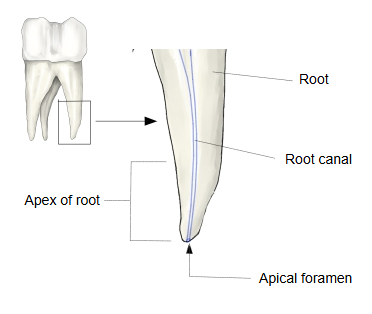
- Root : covered with cementum and set in the tooth socket (alveolus); its tip is the apex of the root
- Neck : the slightly narrowed part at the border between the crown and the root
- Pulp cavity : the space inside that holds the dental pulp (rich in vessels, nerves and lymph vessels); it continues as the root canal to the apical foramen
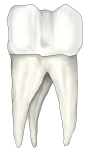 Parts of a tooth
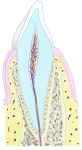 Tooth in its socket (section)
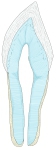 Hard tissues of a tooth (section)
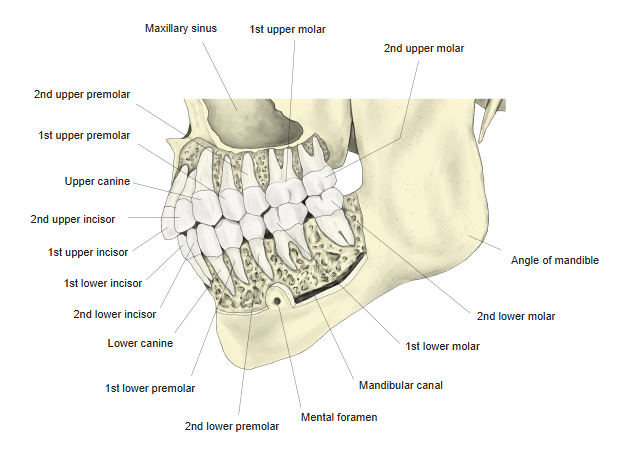
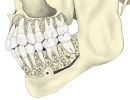 Upper and lower teeth in the jaws
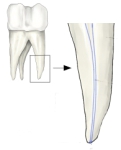 Root, root canal and apex
Roots and root canals by tooth type
The usual numbers of roots and root canals in the permanent teeth are shown below. They vary between people and populations, and sources differ on the details; extra roots are described under accessory root.
| Tooth | Roots | Root canals | |
|---|---|---|---|
| Upper jaw | Central incisor | 1 | 1 |
| Lateral incisor | 1 | 1 | |
| Canine | 1 | 1 | |
| First premolar | 1-2 (buccal and palatal) | 1-2 | |
| Second premolar | 1 | 1-2 | |
| First molar | 3 | 3-4 | |
| Second molar | 3 | 3-4 | |
| Lower jaw | Central incisor | 1 | 1-2 |
| Lateral incisor | 1 | 1-2 | |
| Canine | 1 | 1-2 | |
| First premolar | 1 (rarely 2) | 1-2 | |
| Second premolar | 1 (rarely 2) | 1-2 | |
| First molar | 2 (sometimes 3) | 3-4 | |
| Second molar | 2 (sometimes fused into 1) | 2-3 (sometimes more) |
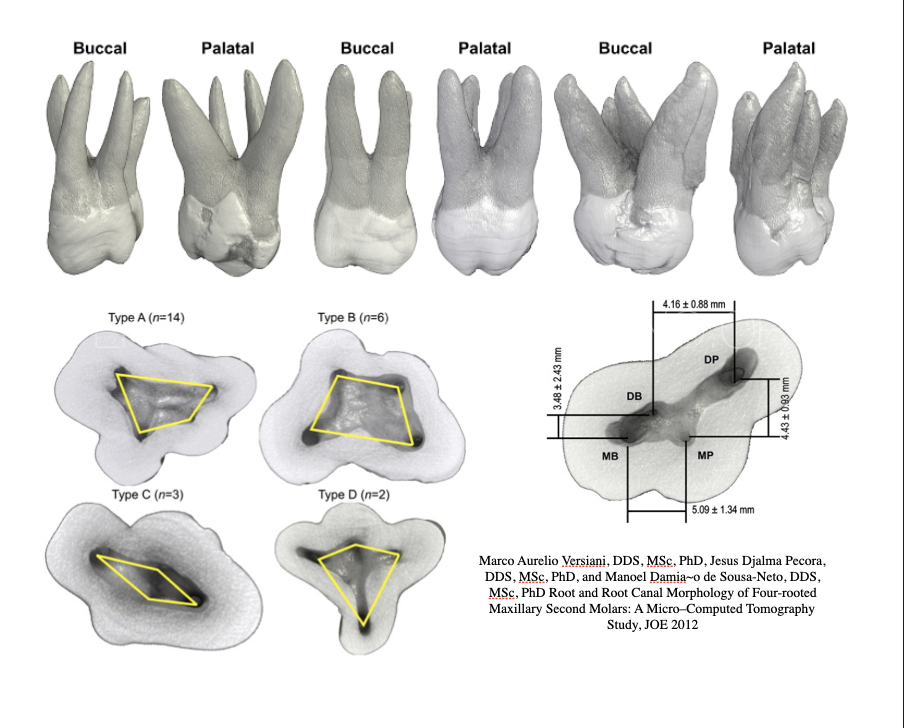
When a molar has four roots
Molars, mainly upper molars, sometimes have four roots: the palatal root is doubled, giving mesiopalatal and distopalatal roots beside the two buccal roots. Some sources note that the roots of such teeth are often strongly curved.
· Four-rooted molar: illustrations and photos, 1
Names of the roots
In a tooth with more than one root, each root is named after the side of the tooth on which it lies: buccal (cheek side), palatal or lingual (tongue side), mesial (toward the midline along the arch) and distal (away from it). The usual names are shown below; usage varies a little between sources.
| Number of roots | Usual teeth | Names of the roots |
|---|---|---|
| Two | Lower molars | mesial root and distal root |
| Two | Upper first premolar | buccal root and palatal root |
| Three | Upper molars | mesiobuccal root, distobuccal root and palatal (lingual) root |
| Three (variant) | Lower first molar | mesial and distal roots with an extra distolingual root (radix entomolaris) |
| Four (uncommon) | Mainly upper molars | mesiobuccal and distobuccal roots, with mesiopalatal and distopalatal roots |
Reference websites
[Wikipedia]
· Tooth, Wikipedia.
· Root (tooth), Wikipedia.
[Websites with illustrations]
· Tooth anatomy (Blausen) (Wikimedia Commons)
· Your tooth's anatomy (dentistinwestcolumbia.com)

Related terms
- Neck of tooth
- Apex of root of tooth
- Pulp cavity of crown
- Dental tubercle
- Teeth
- Crown
- Root canal
- Accessory root
- Periodontal ligament
- Alveolar process
- Cement lacuna
References and sources
- Further reading: Tooth, Wikipedia.
- Further reading: Root (tooth), Wikipedia.
- Federative International Programme for Anatomical Terminology (FIPAT). Terminologia Anatomica, 2nd ed. (TA2), 2019.