Oblique cord (Latin: chorda obliqua)
Also called Oblique cord of forearm
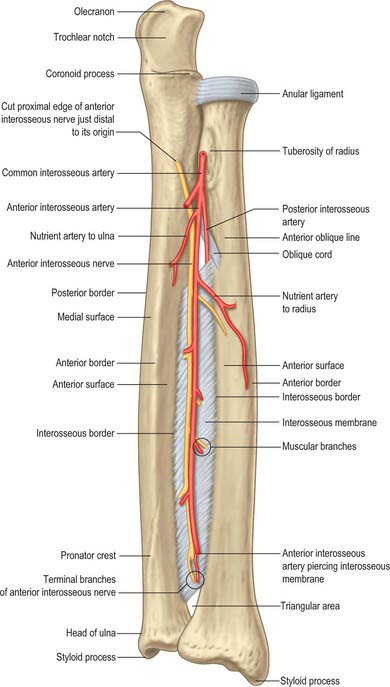
It is a small, flat band that runs downwards and laterally from the ulna, near the base of the coronoid process, to the radius. Its fibres run in the opposite direction to most fibres of the interosseous membrane of the forearm.
The gap between the oblique cord and the upper border of the interosseous membrane is the passage through which the posterior interosseous artery reaches the back of the forearm.
A study of 38 arms found a mean length of 3.4 cm (range 2.4 to 4.2 cm); in most arms the cord tapers from the ulna to the radius, being about 9 mm wide at the ulna, 7 mm in the middle and 4 mm at the radius.
Its function is unclear; it may help to limit supination. In some people it is thin or absent, and some regard it as a remnant of a muscle; sources differ on its size and attachments.
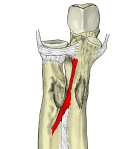 Right radius and ulna (anterior view)
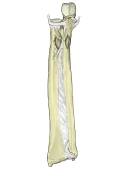 Right radius and ulna (anterior view)
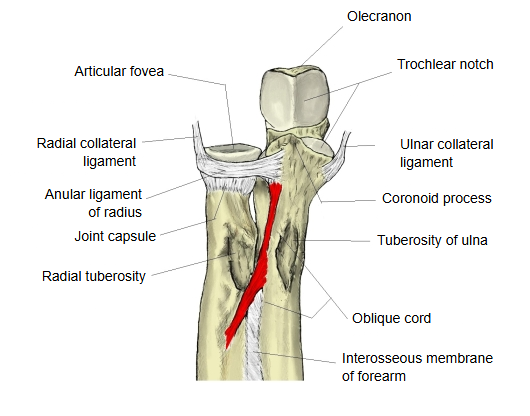
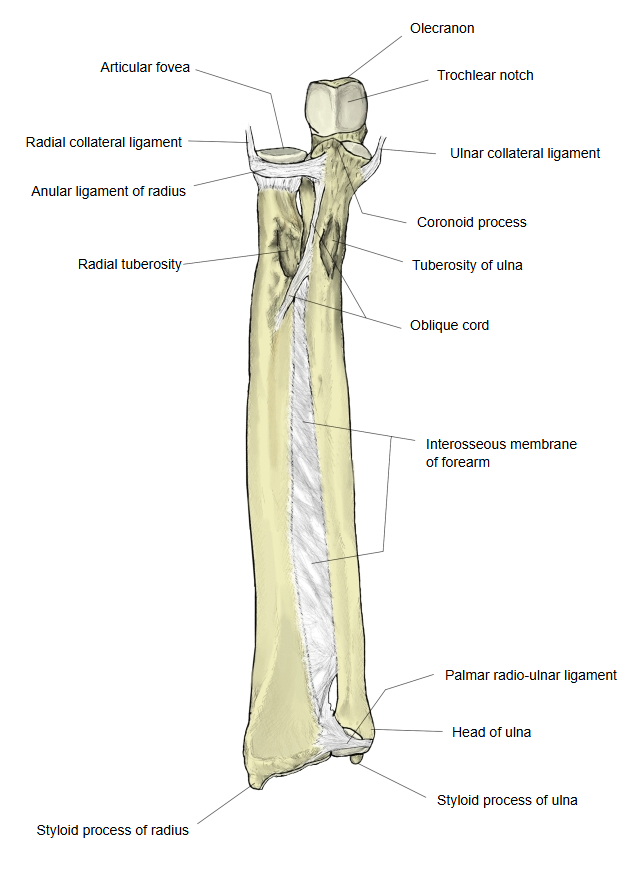
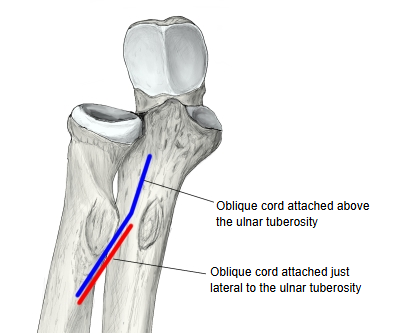
Note: the length probably varies so much because the attachment on the ulna lies in some people just lateral to the tuberosity of the ulna and in others well above it (see the figure).
Reference websites
[Wikipedia]
· Oblique cord, Wikipedia.
[Websites with illustrations]
· Elbow joint from the medial side with the oblique cord (Gray's Anatomy figure) (Wellness Advocate)

· Radius and ulna with the interosseous membrane and the oblique cord (figure) (Clinical Gate)
Related terms
- Interosseous membrane of forearm
- Tuberosity of ulna
- Radial tuberosity
- Coronoid process of ulna
- Proximal radioulnar joint
- Interosseous border of ulna
- Posterior interosseous artery
References and sources
- Further reading: Oblique cord, Wikipedia.
- Federative International Programme for Anatomical Terminology (FIPAT). Terminologia Anatomica, 2nd ed. (TA2), 2019.