Coronoid process of ulna (Latin: processus coronoideus ulnae)
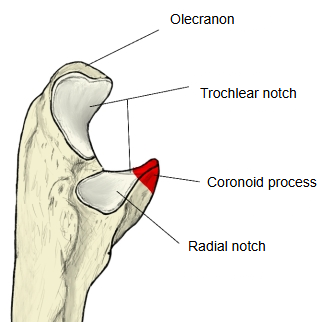
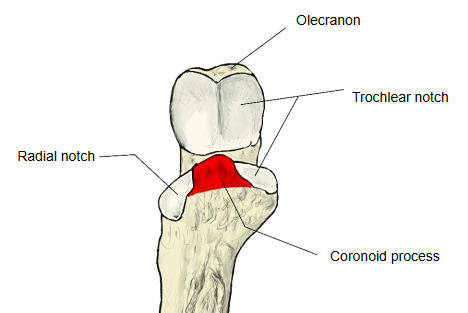
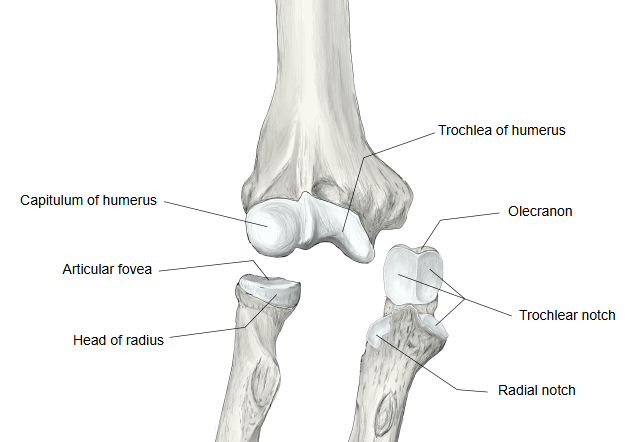
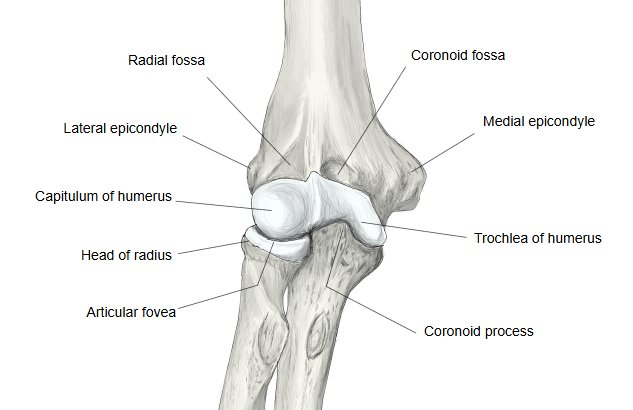
· Its upper surface is the lower part of the trochlear notch, which meets the trochlea of the humerus at the humeroulnar joint.
· When the elbow is fully bent, its tip fits into the coronoid fossa of the humerus.
· On its lateral side lies the radial notch, where the head of the radius turns at the proximal radioulnar joint.
· The mandible also has a process of the same name (see coronoid process); it should not be confused with the coracoid process of the scapula either.
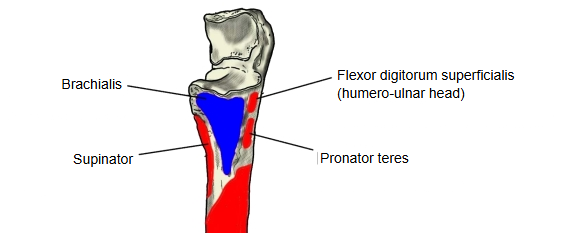
· Muscles (insertion): its rough front surface receives part of brachialis, together with the tuberosity of ulna just below. Muscles (origin): the ulnar head of pronator teres and the humero-ulnar head of flexor digitorum superficialis arise from its medial side, and part of flexor digitorum profundus just behind them.
· Ligament: the anterior band of the ulnar collateral ligament of elbow is attached to its medial edge.
· Fractures of the coronoid process often occur with posterior dislocation of the elbow.
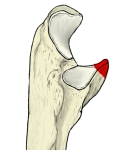 Right ulna, upper end (lateral)
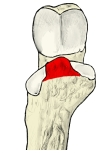 Right ulna, upper end (anterior)
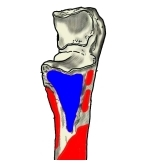 Muscle attachments (anterior)
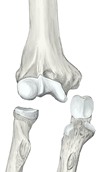 Right elbow, bones apart (anterior)
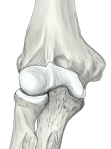 Right elbow joint (anterior)
· Video: The ulna - skeleton of the upper limb.
Reference websites
[Wikipedia]
· Coronoid process of the ulna, Wikipedia.
· Ulna, Wikipedia.
[Websites with illustrations]
· Upper end of the left ulna, lateral aspect (Gray's Anatomy, fig. 212) (Wikimedia Commons)

· Bones of the left forearm, anterior aspect (Gray's Anatomy, fig. 213) (Wikimedia Commons)

· The ulna (TeachMeAnatomy)
Where it is found
Related terms
References and sources
- Further reading: Coronoid process of the ulna, Wikipedia.
- Further reading: Ulna, Wikipedia.
- Federative International Programme for Anatomical Terminology (FIPAT). Terminologia Anatomica, 2nd ed. (TA2), 2019.