Suspensory muscle of duodenum (Latin: musculus suspensorius duodeni)
Also called the suspensory ligament of duodenum or the ligament of Treitz
· It is also called the suspensory ligament of the duodenum; in that case the English name uses "ligament".
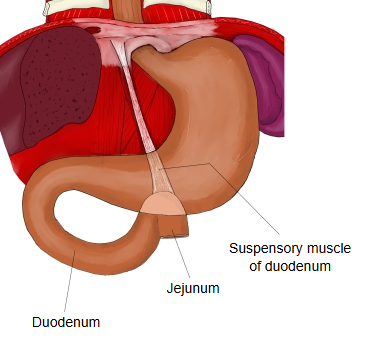
It runs from the right crus of the diaphragm, passing near the coeliac trunk and behind the pancreas, down to the end of the ascending part of the duodenum and the duodenojejunal flexure, which it holds up. It is smooth muscle mixed with connective tissue; its upper part may contain skeletal muscle fibres from the diaphragm, which is why sources call it either a muscle or a ligament. By shortening it is thought to widen the angle of the flexure and help contents pass into the jejunum. Clinically it marks the boundary between the upper and lower gastrointestinal tract: bleeding above it is called upper GI bleeding.
Reference websites
[Wikipedia]
· Suspensory muscle of duodenum, Wikipedia.
[Websites with illustrations]
· Ligament of Treitz (shown in green) (Kenhub)

· Ligament of Treitz and the supra- and inframesocolic compartments (Springer Nature)

· Ligament of Treitz (Radiopaedia)
Related terms
- Longitudinal fold of duodenum
- Duodenal glands
- Hidden part of duodenum
- Duodenojejunal flexure
- Duodenum
- Jejunum
- Duodenal fossae
- Inferior duodenal flexure
- Root of mesentery
References and sources
- Further reading: Suspensory muscle of duodenum, Wikipedia.
- Federative International Programme for Anatomical Terminology (FIPAT). Terminologia Anatomica, 2nd ed. (TA2), 2019.