Root of mesentery (Latin: radix mesenterii)
· It arises from the parietal peritoneum and runs obliquely, from the duodenojejunal flexure on the left side of the second lumbar vertebra, down and to the right to the right iliac fossa, near the right sacroiliac joint. Because the root is short while the intestinal border of the mesentery is several metres long, the mesentery has a fan-like, pleated shape.
· On its way it crosses the horizontal (third) part of the duodenum, the abdominal aorta, the inferior vena cava, the right ureter and the right psoas major.
· The superior mesenteric artery and vein enter the mesentery at its root, between its two layers of peritoneum, together with lymph vessels and nerves.
· It divides the space below the transverse mesocolon into the right and left infracolic spaces.
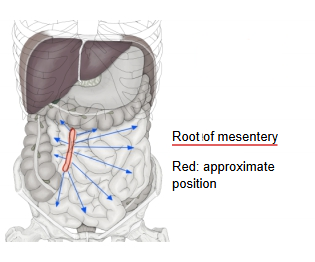
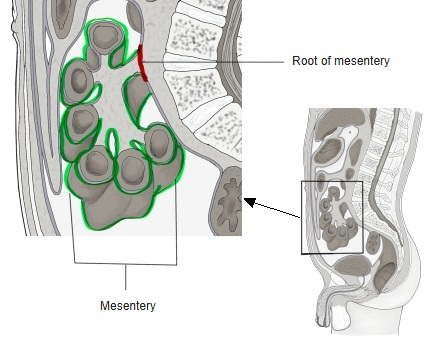
Where it is found
Related terms
- Mesentery
- Jejunum
- Ileum
- Small intestine
- Duodenojejunal flexure
- Transverse mesocolon
- Superior mesenteric artery
References and sources
- Further reading: Mesentery, Wikipedia.
- Federative International Programme for Anatomical Terminology (FIPAT). Terminologia Anatomica, 2nd ed. (TA2), 2019.