Vermilion of lip
Also called: vermilion; vermilion zone; red part of lip; transition part of lip
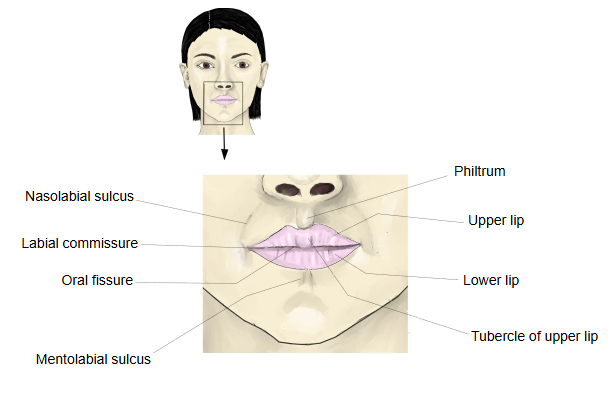
· What people usually call the lips is this part; because it is strongly red, anatomists call it the red part of the lip or the vermilion, and its edge the vermilion border.
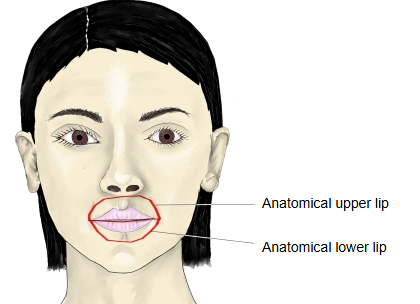
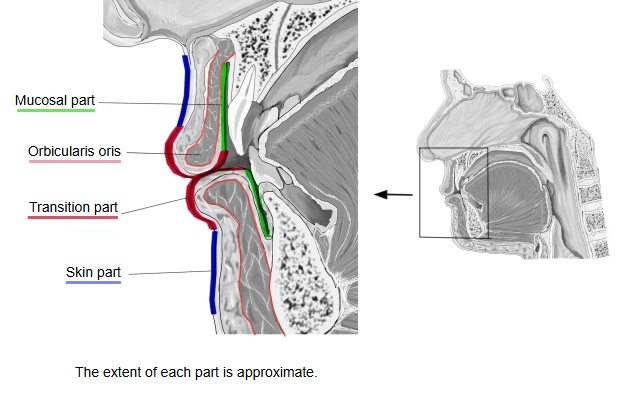
In anatomy the lips are larger than the vermilion: the upper lip reaches up to the nasolabial sulcus and the lower lip down to the mentolabial sulcus. The vermilion is the transition part between the skin part outside and the mucosal part inside. Its covering is thin and lightly keratinised, without hair, sweat glands or (usually) sebaceous glands; tall connective-tissue papillae bring capillaries close to the surface, so it looks red. Because it has no glands of its own, it dries and cracks easily. Its sharp outer edge against the facial skin is the vermilion border; on the upper lip this border forms Cupid's bow, with the tubercle of the upper lip in the middle, below the philtrum. The lips close around the oral fissure, and under them lies the orbicularis oris.
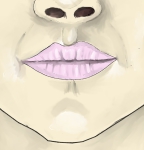 Lips
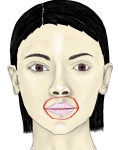 Anatomical lips
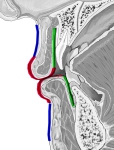 Structure of the lips
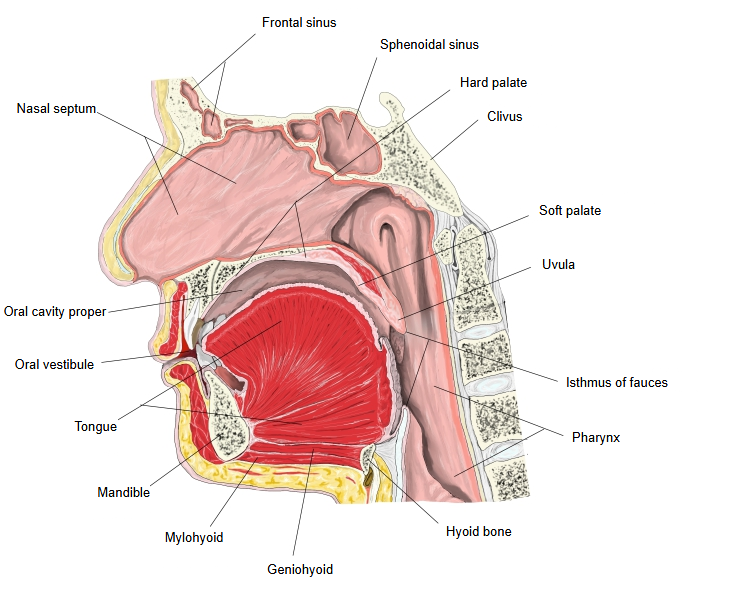
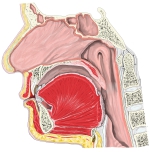 Nasal cavity, oral cavity and pharynx (median section)
Related terms
References and sources
- Further reading: Vermilion border, Wikipedia.
- Further reading: Lip, Wikipedia.
- Federative International Programme for Anatomical Terminology (FIPAT). Terminologia Anatomica, 2nd ed. (TA2), 2019.