Nail matrix (Latin: matrix unguis)
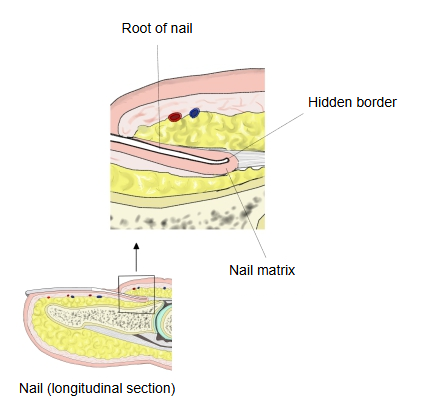
The nail matrix is the back part of the nail bed, lying under the root of the nail; it is where the new nail is formed.
Root of nail: the back part of the nail hidden under the skinIt extends forwards as far as the lunula, which is its visible front part
· Its cells multiply, fill with hard keratin and become the nail plate, which is pushed slowly forwards over the nail bed. If a nail is lost but the matrix is intact, a new nail grows; if the matrix is damaged, the nail may grow back deformed or not at all.
Nail and
its
surroundings
its
surroundings
- Nail plate
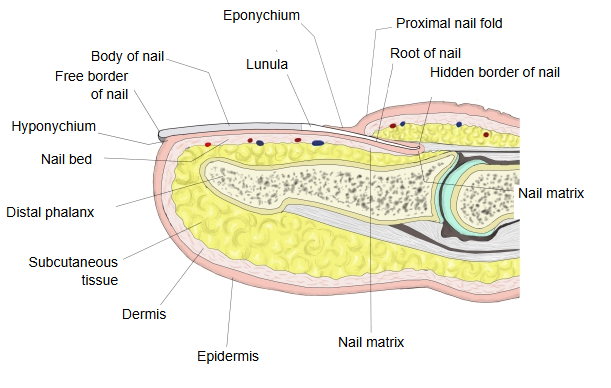
- Body of nail : the exposed front part; its tip is the free border. Lunula: the half-moon at its base.
- Root of nail : the back part hidden under the skin; its back end is the hidden border.
- Surroundings
- Under the nail: Nail bed : the skin on which the body of the nail rests, with the ridges and grooves of the nail bed.
- Under the nail: Nail matrix : the back end, where the new nail is formed. The hyponychium lies at the very front.
- Over the nail: Eponychium : the thin, semi-transparent horny layer of skin that projects a little from the nail wall.
- Around the nail: Nail wall : the raised fold of skin around the body of the nail; the lateral nail groove is the groove between the nail and the lateral nail wall.
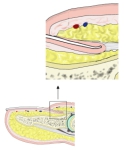 Nail matrix
 Nail (longitudinal section)
Reference websites
[Wikipedia]
· Nail (anatomy), Wikipedia.
[Websites with illustrations]
· Fingernail anatomy (Blausen figure) (Wikimedia Commons)

· Nail matrix (figure) (Cleveland Clinic)
Related terms
- Nail plate
- Nail bed
- Grooves of nail bed
- Ridges of nail bed
- Body of nail
- Lateral nail groove
- Nail wall
- Nails
- Lunula
- Eponychium
- Hyponychium
- Epidermis
- Distal phalanges (hand)
References and sources
- Further reading: Nail (anatomy), Wikipedia.
- Federative International Programme for Anatomical Terminology (FIPAT). Terminologia Anatomica, 2nd ed. (TA2), 2019.