Lenticular process (Latin: processus lenticularis incudis)
The lenticular process of the incus is the rounded, swollen knob at the tip of the long limb of the incus; it forms a joint with the head of stapes.
Incus: one of the auditory ossicles in the tympanic cavityLong limb: runs almost vertically downwards from the body of incus
Incus
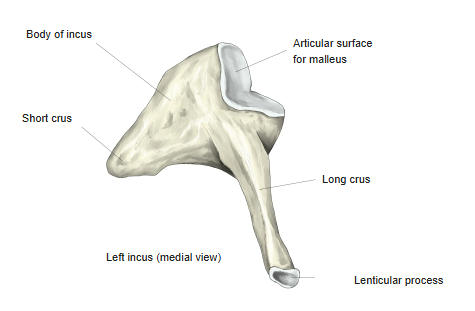
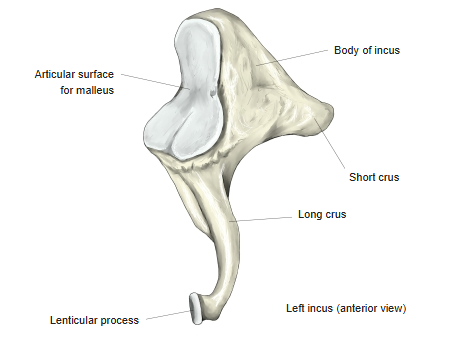
- Body of incus : lies in the epitympanic recess and carries the joint surface for the malleus.
- Limbs (crura)
- Short limb : runs almost horizontally backwards from the body and rests in the fossa of incus.
- Long limb : runs downwards from the body, roughly parallel to the handle of malleus.
- Lenticular process : the small rounded knob at the tip of the long limb that articulates with the head of stapes.
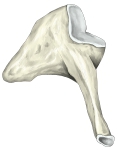 Left incus (medial view)
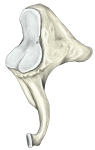 Left incus (anterior view)
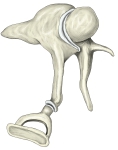 Left auditory ossicles (medial view)
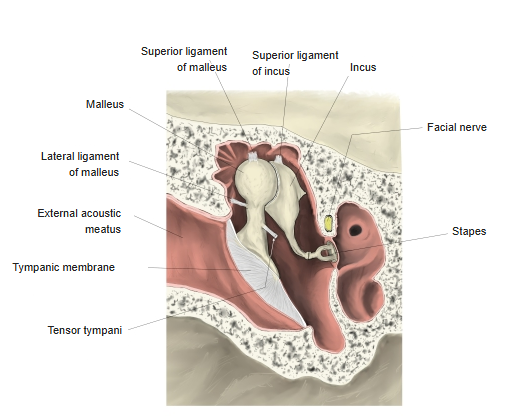
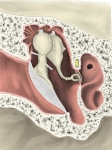 Right tympanic cavity (anterior view)
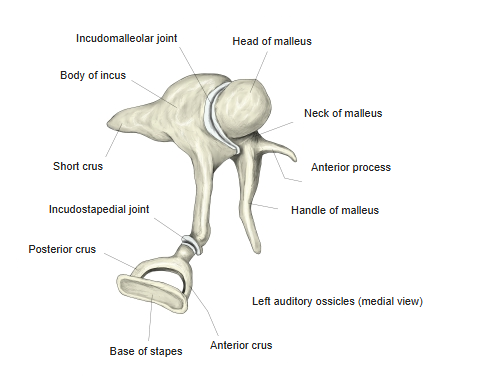
The long limb runs downwards from the body of the incus, behind and roughly parallel to the handle of the malleus; at its lower end it bends medially into the lenticular process. The rounded end of the process forms the incudostapedial joint with the head of the stapes, a tiny synovial joint. Sources differ on its status: it may ossify separately and is then sometimes counted as a small separate bone.
Reference websites
[Wikipedia]
· Incus, Wikipedia.
· Ossicles, Wikipedia.
[Websites with illustrations]
· Left incus (Gray's Anatomy) (Wikimedia Commons)
