Efferent lymphatic vessel (Latin: vas lymphaticum efferens)
- Overview
- How many efferent vessels leave a lymph node?
- Reference websites
- (Wikipedia, websites with illustrations)
- Related terms
Overview
· Like other lymphatic vessels, it has valves that keep the lymph flowing in one direction.
· Lymph enters a node through several afferent lymphatic vessels on its convex surface, passes through the sinuses, where foreign material is removed and lymphocytes are added, and leaves through the efferent vessels at the hilum, beside the artery and vein.
· Efferent vessels are usually fewer and wider than the afferent ones. An efferent vessel either becomes an afferent vessel of the next node in a chain (common in the neck, axilla and mesentery) or joins others to form a lymphatic trunk, which drains into the thoracic duct or the right lymphatic duct.
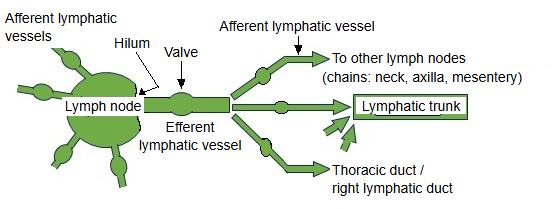
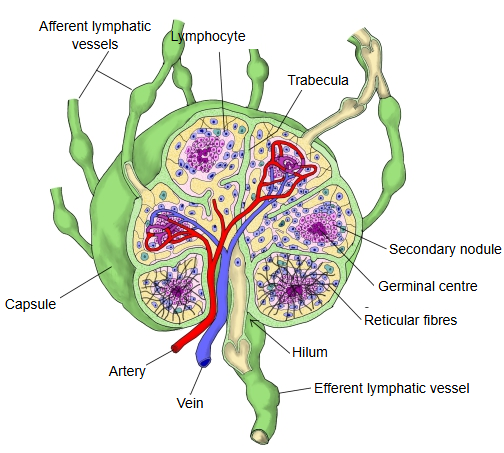
From lymph capillaries to the veins
The lymphatic trunks are the jugular, subclavian, bronchomediastinal and lumbar trunks and the intestinal trunk. The thoracic duct begins with a dilatation, the cisterna chyli, and carries about three quarters of the body's lymph to the veins.
How many efferent vessels leave a lymph node?
Q: How often do several efferent lymphatic vessels leave one lymph node?
A: It depends on the region and on the size of the lymph node, and there are hardly any exact figures. Some anatomical tendencies are known, however.
1. 1. General tendency
· Small lymph nodes (less than about 1 cm across) → often a single efferent vessel
· Large lymph nodes (about 1 cm or more, or nodes in large groups) → two or more efferent vessels may leave
· Especially in the main node groups of the chest, abdomen and pelvis, several efferent vessels are usual.
2. 2. Tendency by region
| Region | Number of efferent vessels (tendency) | |
|---|---|---|
| 1 | Cervical lymph nodes (e.g. deep cervical nodes) | Usually one; large nodes may have two or more |
| 2 | Axillary lymph nodes | Often one or two |
| 3 | Abdominal and lumbar lymph nodes (e.g. around the aorta) | One to three or more are often reported |
| 4 | Mediastinal lymph nodes | Often up to three; the number varies with the lymph flow |
Note: there are almost no statistics giving exact proportions; sources say only that there is usually one, but important nodes may have two or three. Sources also differ on the exact sizes of lymphatic vessels.
Reference websites
[Wikipedia]
· Lymphatic vessel, Wikipedia.
· Lymph node, Wikipedia.
[Websites with illustrations]
· Lymph node with afferent and efferent lymphatic vessels (Study.com)

· Microscopic anatomy of a lymph node: afferent and efferent lymphatic vessels, trabeculae (antranik.org)

Related terms
References and sources
- Further reading: Lymphatic vessel, Wikipedia.
- Further reading: Lymph node, Wikipedia.
- Federative International Programme for Anatomical Terminology (FIPAT). Terminologia Anatomica, 2nd ed. (TA2), 2019.