Alveolar lining layer
Also called alveolar lining fluid
⇒ See the structure of the pulmonary alveoli.
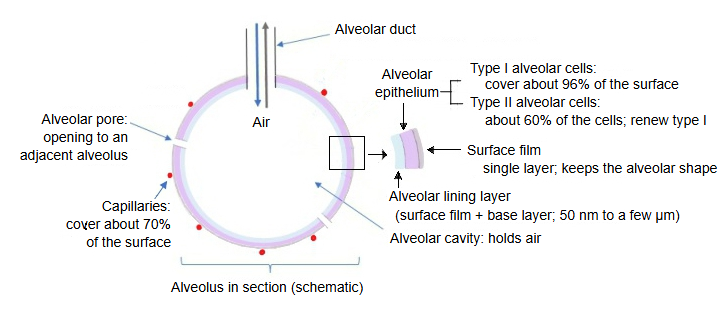
The alveolar lining layer is the thin liquid layer that covers the inner surface of the pulmonary alveoli, between the alveolar cells and the air in the alveolar cavity, so that the alveolar epithelial cells do not touch the air directly. It has two parts: a watery base layer (hypophase) next to the cells, and a very thin surface film of surfactant facing the air. The surface film is a single layer of phospholipids; it lowers surface tension, which keeps the alveoli from collapsing and helps keep their shape. Its thickness varies from place to place, from about 50 nm to a few micrometres. The surfactant is secreted by the type II alveolar cells (the club cells of the bronchioles add some surfactant proteins); the thin type I cells, which cover most of the surface, do not make surfactant.
Related terms
References and sources
- Further reading: Alveolar lining fluid, Wikipedia.
- Further reading: Pulmonary surfactant, Wikipedia.
- Federative International Programme for Anatomical Terminology (FIPAT). Terminologia Anatomica, 2nd ed. (TA2), 2019.