Holocrine secretion
Also called the holocrine
· It is one of the three classic modes of secretion of exocrine glands. In merocrine (eccrine) secretion the product leaves by exocytosis and the cell stays intact; in apocrine secretion the top of the cell is shed with the product; in holocrine secretion the entire cell is lost.
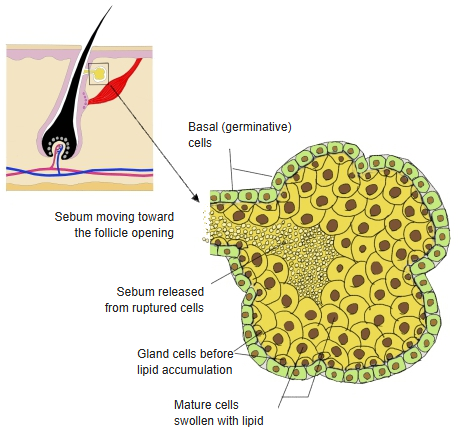
· The lost cells are replaced by division of small basal cells at the edge of the gland, which move inwards, fill with product and finally disintegrate.
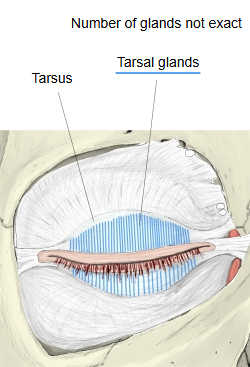
· The main examples are the sebaceous glands of the skin, whose sebum is made of the remains of broken-down cells, and the tarsal (Meibomian) glands of the eyelids, which are modified sebaceous glands.
· Sources differ on whether these three modes cover every kind of gland secretion.
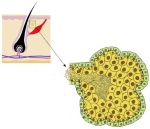 Sebaceous gland
 Tarsal (Meibomian) glands
Related terms
References and sources
- Further reading: Holocrine, Wikipedia.
- Federative International Programme for Anatomical Terminology (FIPAT). Terminologia Anatomica, 2nd ed. (TA2), 2019.