Exocrine gland (Latin: glandula exocrina)
- Overview
- Modes of secretion
- Why leakage is not secretion
- Classification
- Kinds of exocrine gland
- Reference websites
- (Wikipedia, websites with illustrations)
- Related terms
Overview
- Exocrine glands
- Onto the body surface : sweat glands (eccrine and apocrine), sebaceous glands, mammary gland (= skin glands)
- Into the digestive tract : salivary glands, pancreas, liver, gastric glands, duodenal glands
- Others : nasal glands
- Endocrine glands
- In the brain : pituitary gland, pineal gland
- In the neck : thyroid gland, parathyroid glands
- In the abdomen : suprarenal glands, pancreas (islets)
- Reproductive organs : gonads: ovaries (with the corpus luteum) and testes; in pregnancy also the placenta
Note: the goblet cell, one of the exocrine cells, forms no gland structure, so it is not counted here as an exocrine gland (some texts call it a unicellular exocrine gland).
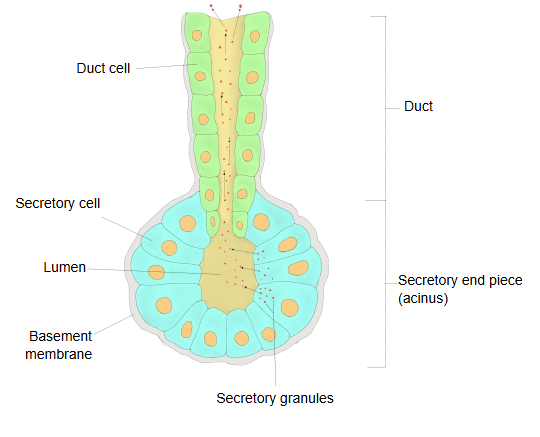
- Exocrine cells : one kind of secretory cell; some form gland structures, most often an acinus, and some do not, such as the goblet cell.
- Lumen : the space inside the acinus, where the secretion is first released (acinar lumen).
- Duct : the route that carries the secretion away from the lumen; some duct cells also secrete or change the secretion.
· The part where the gland cells of an exocrine gland gather (the acini or tubules) is called the secretory end piece (terminal portion).
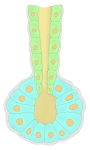 Structure of an exocrine gland
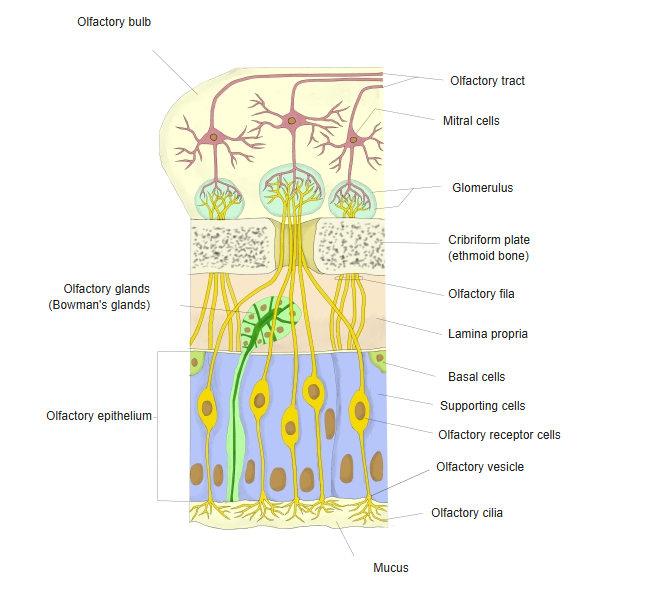
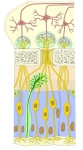 Olfactory glands (nasal mucosa)
Modes of secretion
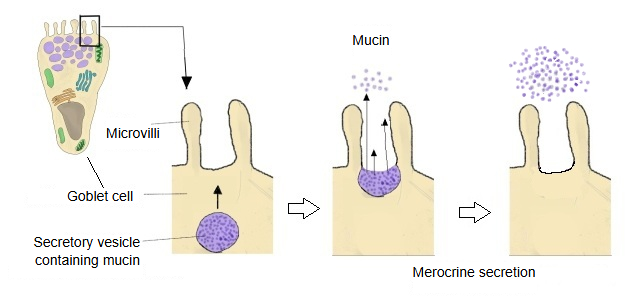
Exocrine glands are also classified by how the gland cells release their product. In a holocrine gland, such as a sebaceous gland, the cell stores its secretion inside, then breaks down as a whole and is discharged. In an eccrine (merocrine) gland the cell stays intact and only the product leaves it. Between them is the apocrine mode: the cell stores its product, and the part of the cell holding it is pinched off and released, while the rest of the cell survives and goes on secreting. Eccrine and apocrine release are not sharply separated: tiny fragments of cytoplasm are sometimes seen leaving eccrine gland cells too. The best-known apocrine gland is the mammary gland, whose fat droplets are released this way (its proteins by exocytosis).
- Holocrine glands : the gland cell makes and stores the product ⇒ the cell breaks down ⇒ the product is released. Examples: sebaceous glands, tarsal (meibomian) glands.
- Eccrine (merocrine) glands : the cell does not break down; only the product is released. Example: eccrine (small) sweat glands.
- Apocrine glands : the cell makes and stores the product ⇒ part of the cell is pinched off ⇒ the product is released. Examples: apocrine (large) sweat glands, mammary gland.
Modes of secretion are usually limited to the following three:
| Mode | Description | Examples | |
|---|---|---|---|
| 1 | Merocrine secretion (= eccrine secretion, exocytosis) | Only the product is released, in vesicles; the cell itself is not damaged. | Pancreatic acinar cells, salivary glands (e.g. the parotid gland), goblet cells |
| 2 | Apocrine secretion | Part of the cell (some cytoplasm with its membrane) is pinched off with the product. | Mammary gland (fat droplets), axillary sweat glands (now thought to secrete mainly by the merocrine mode; sources differ) |
| 3 | Holocrine secretion | The whole cell breaks down and becomes the secretion. | Sebaceous glands |
"Eccrine secretion" is simply another name for merocrine secretion.
Is eccrine secretion then a fourth mode outside the three above?
No: eccrine (merocrine) secretion is the first of the three. What is not counted as a mode of secretion is the simple leakage or diffusion of substances out of a cell.
Why leakage is not secretion
· It is not active, regulated "secretion" but simple "diffusion" or "leakage".
· In cells built for secretion, such as gland tissue, only regulated, active secretion is counted.
· It does not use secretory granules or vesicles, so strictly it is a way substances move, not a secretory mechanism.
Classification
1. 1. By the position of the gland cells relative to the epithelium: intraepithelial glands (within the epithelium) and extraepithelial glands (below it, joined to the surface by a duct).
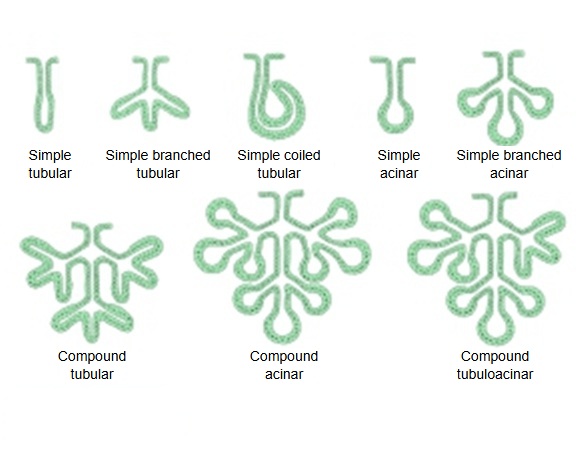
2. 2. By the combination of secretory end pieces and ducts: simple glands have one unbranched duct, compound glands a branching duct system; by the shape of the end pieces they are tubular, acinar (alveolar) or tubuloacinar.
| Type | Examples | |
|---|---|---|
| 1 | Simple tubular gland | Intestinal glands (crypts of Lieberkühn) of the large intestine |
| 2 | Simple branched tubular gland | Pyloric glands of the stomach, uterine (endometrial) glands |
| 3 | Simple coiled tubular gland | Eccrine sweat glands |
| 4 | Simple acinar (alveolar) gland | Rare in humans; examples differ between sources |
| 5 | Simple branched acinar gland | Sebaceous glands |
| 6 | Compound tubular gland | Duodenal (Brunner's) glands |
| 7 | Compound acinar (alveolar) gland | Exocrine part of the pancreas (also described as tubuloacinar) |
| 8 | Compound tubuloacinar gland | Major salivary glands (parotid, submandibular and sublingual glands) |
Kinds of exocrine gland
The list below may not include every exocrine gland.
| Onto the body surface | 1 | Sweat glands | Glands in the skin that secrete sweat: eccrine and apocrine sweat glands |
| 2 | Sebaceous glands | Small glands that secrete sebum, in the skin of almost the whole body except the palms and soles | |
| 3 | Mammary gland | (Female) a mass of small lobes in the breast that secrete milk; not functional in males | |
| Into the digestive tract | 1 | Salivary glands | The major salivary glands, such as the parotid gland, and the minor salivary glands in the mucosa; they produce saliva |
| 2 | Pancreas | A serous compound acinar gland; the acinar cells of its end pieces (acini) are cuboidal to pyramidal | |
| 3 | Liver | Produces bile (alkaline), which is stored and concentrated in the gallbladder and flows through the bile duct into the duodenum | |
| 4 | Gastric glands | Cardiac glands (secrete mucus), fundic glands (secrete gastric juice), pyloric glands (secrete mucus) | |
| 5 | Duodenal glands | Produce an alkaline secretion rich in mucus; = Brunner's glands | |
| 6 | Intestinal glands | In the epithelium of the small and large intestine; secrete various enzymes; = intestinal crypts | |
| Reproductive organs | 1 | Bulbourethral (Cowper's) glands | (Male) two pea-sized glands beside the urethra; secrete bulbourethral fluid |
| 2 | Prostate | (Male) secretes prostatic fluid, which is slightly alkaline and contains sugars, proteins and other substances | |
| 3 | Paraurethral (Skene's) glands | (Female) release a clear or milky fluid near the urethral opening; they correspond to the male prostate | |
| 4 | Greater vestibular (Bartholin's) glands | (Female) a pair, one on each side of the vaginal opening; secrete mucus | |
| Others | 1 | Nasal glands | Mixed glands in the lamina propria of the respiratory part of the nasal mucosa; produce nasal mucus. The olfactory glands lie in the olfactory part. |
| 2 | Lacrimal gland | The gland at the upper lateral side of the eyeball that secretes tears |
Reference websites
[Wikipedia]
· Exocrine gland, Wikipedia.
· Gland, Wikipedia.
[Websites with illustrations]
· Epithelial tissue (glandular epithelium, modes of secretion) (OpenStax Anatomy and Physiology)
· Epithelial tissue (SEER Training (NCI))
Related terms
- Endocrine glands
- Serous gland
- Salivary glands
- Sweat glands
- Sebaceous glands
- Mammary gland
- Lacrimal gland
References and sources
- Further reading: Exocrine gland, Wikipedia.
- Further reading: Gland, Wikipedia.
- Federative International Programme for Anatomical Terminology (FIPAT). Terminologia Anatomica, 2nd ed. (TA2), 2019.