Alveolar part of mandible (Latin: pars alveolaris mandibulae)
Also called the alveolar part
The alveolar part of the mandible is the upper of the two parts of the body of the mandible: the curved, tooth-bearing part that holds the dental alveoli.
Mandible: one of the bones of the facial skeleton (lower jaw)Dental alveoli: the sockets into which the roots of the lower teeth fit, eight on each side in the adult
Anatomy textbooks divide the body of the mandible as follows.
The body is a flattened, curved plate with an outer and an inner surface and an upper and a lower part. The upper part is the alveolar part; the lower part is the base of the mandible. The alveolar part is the lower-jaw counterpart of the alveolar process of the maxilla. After the teeth are lost, its bone is resorbed and the part becomes lower.
The alveolar part is made up of the following parts.
Alveolar
part
part
- Dental alveoli : the sockets in the upper and lower jaws into which the roots of the teeth fit; eight on each side of each jaw in the adult.
- Interradicular septa : thin bony walls between the roots of a multi-rooted tooth, such as a molar.
- Interalveolar septa : bony walls between neighbouring sockets.
- Alveolar yokes : low ridges on the outer surface of the alveolar part over the roots, most marked over the front teeth.
- Alveolar arch : the curved upper border of the alveolar part, formed by the row of sockets in which the roots of the teeth are set.
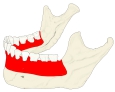 Alveolar part (mandible)
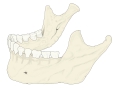 Mandible (lateral)
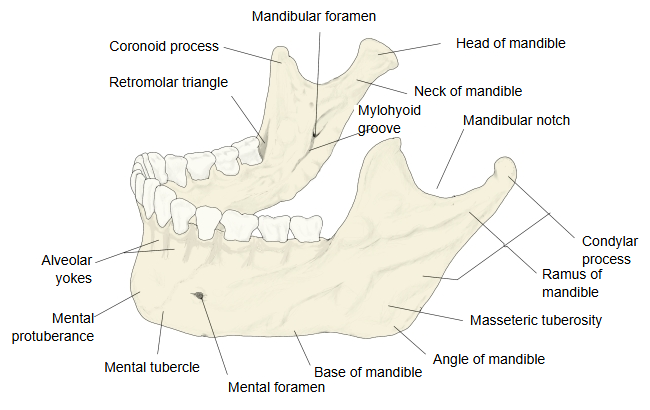
Related terms
- Body of mandible
- Dental alveoli
- Alveolar arch
- Alveolar yokes
- Interalveolar septa
- Interradicular septa
- Alveolar process
References and sources
- Further reading: Mandible, Wikipedia.
- Further reading: Alveolar process, Wikipedia.
- Federative International Programme for Anatomical Terminology (FIPAT). Terminologia Anatomica, 2nd ed. (TA2), 2019.