Alveolar yokes (Latin: juga alveolaria)
Also called Alveolar yoke (singular) or the alveolar eminences
· They are most prominent over the canine, whose root is the longest, and next over the incisors.
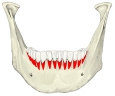 Alveolar yokes (mandible)
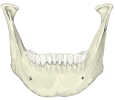 Mandible (anterior)
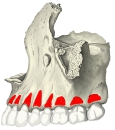 Alveolar yokes (maxilla)
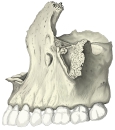 Maxilla (lateral)
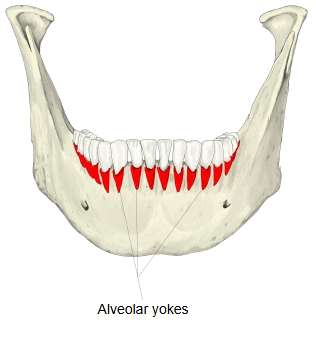
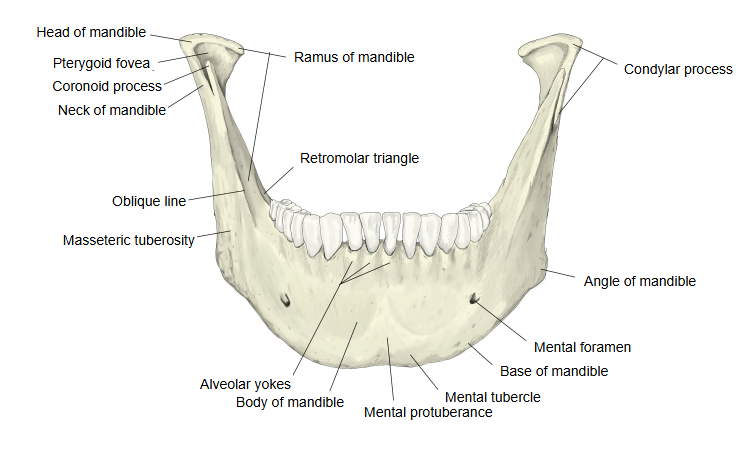
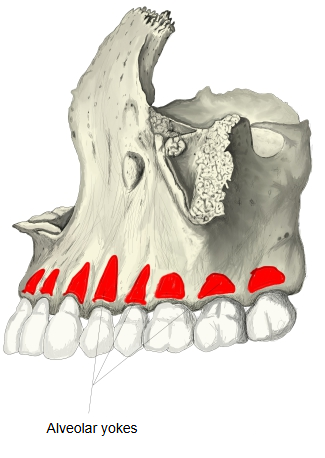
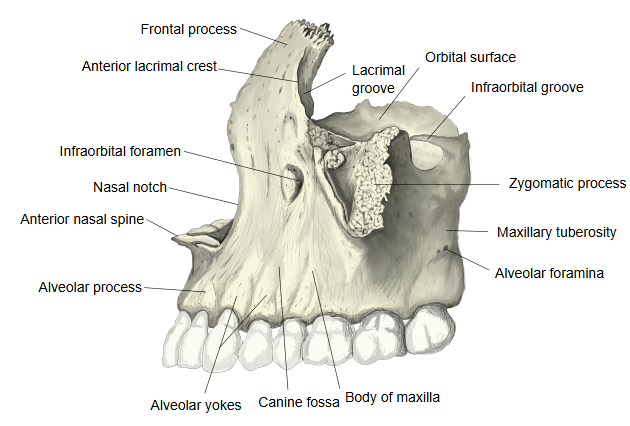
The sockets raise the alveolar yokes on the outer surface of the alveolar process of the maxilla and the alveolar part of the mandible: the outer (labial or buccal) wall of each socket is thin, so the shape of the root shows through as a ridge. On the maxilla the canine yoke (canine eminence) separates two depressions: medially, above the incisors, the shallow incisive fossa, and laterally the deeper canine fossa. Part of the buccinator arises from the alveolar bone over the second and third molars, where the yokes are low.
Reference websites
[Wikipedia]
· Alveolar process, Wikipedia.
[Websites with illustrations]
· The maxilla: landmarks and articulations (TeachMeAnatomy)
· Maxilla: anatomy, function and clinical notes (Kenhub)
Related terms
- Dental alveoli
- Alveolar border
- Alveolar canals
- Alveolar arch
- Alveolar foramina
- Alveolar bone
- Alveolar crest
- Gingival sulcus
- Apical foramen
- Alveolar process
- Canine fossa
- Body of mandible
- Incisor
- Root of tooth
- Maxilla
- Mandible
References and sources
- Further reading: Alveolar process, Wikipedia.
- Federative International Programme for Anatomical Terminology (FIPAT). Terminologia Anatomica, 2nd ed. (TA2), 2019.