Alveolar arch (Latin: arcus alveolaris)
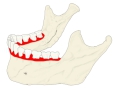 Alveolar arch (mandible)
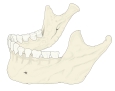 Mandible (lateral)
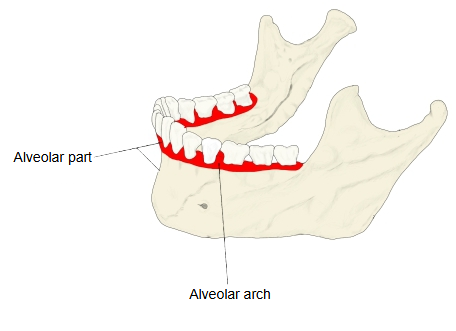
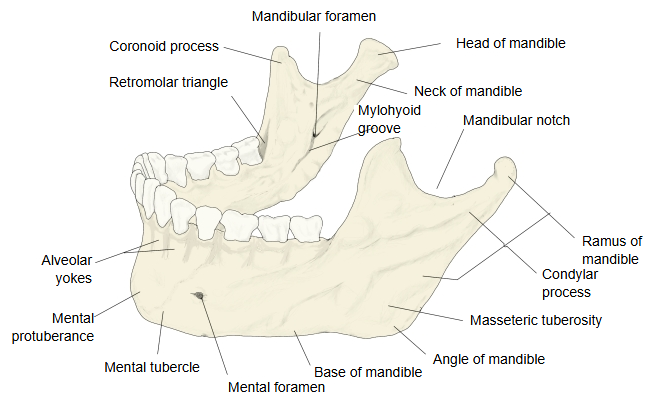
Anatomy textbooks describe it as follows.
The upper edge of the alveolar part (upper part) of the body of the mandible is called the alveolar arch. It contains the dental alveoli (tooth sockets) for the roots of the lower teeth: in the adult 16 sockets, eight on each side.
The upper border of the body of the mandible is the alveolar part, and its lower border is the base of the mandible. The row of sockets is horseshoe-shaped (parabolic) when seen from above and follows the curve of the dental arch. In the upper jaw the alveolar arch is the lower edge of the alveolar processes of the maxilla; the processes of the right and left maxillae meet in the midline to form a single arch. After the teeth are lost, the bone of the arch is resorbed and the arch becomes lower and narrower.
Related terms
- Dental alveoli
- Alveolar border
- Alveolar canals
- Alveolar foramina
- Alveolar bone
- Alveolar yokes
- Alveolar crest
- Gingival sulcus
- Apical foramen
- Alveolar process
- Dental arch
- Body of mandible
- Base of mandible
- Interradicular septa
- Mandible
- Maxilla
References and sources
- Further reading: Alveolar process, Wikipedia.
- Further reading: Mandible, Wikipedia.
- Federative International Programme for Anatomical Terminology (FIPAT). Terminologia Anatomica, 2nd ed. (TA2), 2019.