Compact bone (Latin: substantia compacta)
Also called Compact substance or the cortical bone
Compact bone is the dense, hard bone tissue that forms the outer wall of bones.
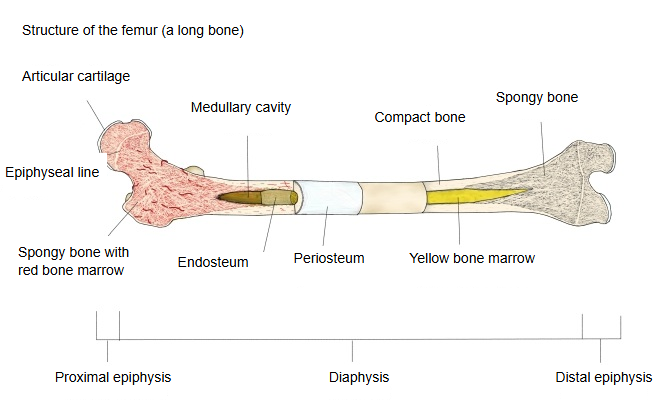
Bone is made of an outer layer of compact bone and an inner network of thin plates and bars, the spongy (cancellous) bone.
Compact bone is thickest in the shaft (diaphysis) of long bones, where it surrounds the medullary cavity; at the ends (epiphyses) it is only a thin shell over spongy bone.
It is built of tightly packed osteons (Haversian systems): rings of bone lamellae around central canals, joined by perforating (Volkmann's) canals that carry vessels and nerves.
It gives the bone most of its strength and resistance to bending and loading. On the outside it is covered by the periosteum; on the inside it is lined by the endosteum.
Related terms
References and sources
- Further reading: Bone, Wikipedia.
- Federative International Programme for Anatomical Terminology (FIPAT). Terminologia Anatomica, 2nd ed. (TA2), 2019.