Medullary cavity (Latin: cavitas medullaris)
Also called the marrow cavity.
Bones of other shapes, such as short bones and flat bones, have no medullary cavity, but they still contain a fair amount of bone marrow among the trabeculae of their spongy bone.
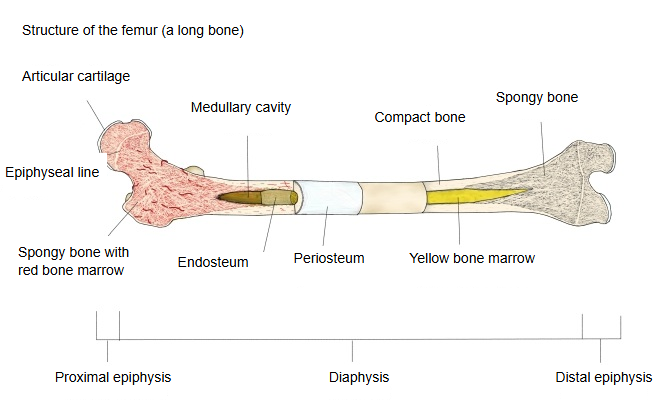
The medullary cavity is the central cavity of the shaft (diaphysis) of a long bone, where red and/or yellow bone marrow is stored. The shaft is made mostly of compact bone; towards the ends the cavity is bordered by spongy bone, and it is lined by the thin, vascular endosteum. In a wider sense, any marrow-filled space inside a bone may be called a medullary cavity. The red marrow here takes part in making red and white blood cells. 'Intramedullary' means inside the bone, as in intramedullary nails used to fix fractures of long bones.
Reference websites
[Wikipedia]
· Medullary cavity, Wikipedia.
· Long bone, Wikipedia.
[Websites with illustrations]
· Structure of a long bone (Wikimedia Commons)

· Bone cross-section (Wikimedia Commons)

Related terms
References and sources
- Further reading: Medullary cavity, Wikipedia.
- Further reading: Long bone, Wikipedia.
- Federative International Programme for Anatomical Terminology (FIPAT). Terminologia Anatomica, 2nd ed. (TA2), 2019.