Stratum corneum (Latin: stratum corneum epidermidis)
Also called the horny layer or cornified layer
of the
epidermis
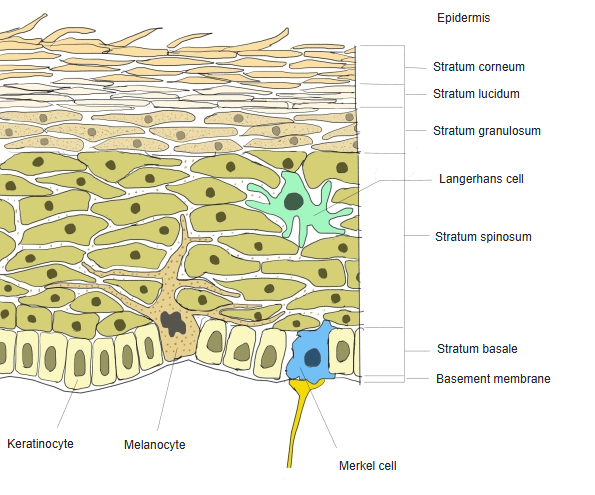
- Stratum corneum : the outermost layer, made of dead keratinocytes; the surface (stratum disjunctum) is constantly shed (desquamation).
- Stratum lucidum : a clear, bright layer at the bottom of the stratum corneum, seen only in thick skin (fingertips, palms, soles); its cells have no nuclei.
- Stratum granulosum : 2–3 rows of many-sided cells with keratohyalin granules in their cytoplasm; the nuclei begin to break down.
- Stratum spinosum : stacked rows of many-sided keratinocytes; the thickest layer in most skin; the cells are joined by intercellular bridges.
- Stratum basale : a single layer of columnar basal cells (keratinocytes); also melanocytes and Merkel cells.
· Unlike the living germinal layer below it, the stratum corneum is keratinized, and keratinization is most advanced near the surface.
· Its cells (corneocytes) contain keratin. They are the last stage of the keratinocytes, which move up from the stratum basale, lose their nuclei and organelles and become flat, keratin-filled scales.
· It is the outermost cell layer of the body; it is usually about 10 to 30 cell layers thick (more in thick skin), with an average thickness of about 0.02 mm in thin skin.
· It holds water in the skin surface and keeps the body from drying out.
· It plays a key part in the barrier function of the skin and in keeping the skin moist. The cells are held together by modified desmosomes and surrounded by layers of lipids released from the stratum granulosum; this makes the stratum corneum the main barrier against water loss and against the entry of foreign substances.
Reference websites
[Wikipedia]
· Stratum corneum, Wikipedia.
· Epidermis, Wikipedia.
Related terms
- Stratum disjunctum
- Stratum granulosum
- Keratohyalin granule
- Epidermis
- Keratinocyte
- Dermis
- Skin
- Germinal layer
- Hypodermis (subcutaneous tissue)
References and sources
- Further reading: Stratum corneum, Wikipedia.
- Further reading: Epidermis, Wikipedia.
- Federative International Programme for Anatomical Terminology (FIPAT). Terminologia Anatomica, 2nd ed. (TA2), 2019.