Meissner's corpuscle (Latin: corpusculum tactile)
Also called the tactile corpuscle
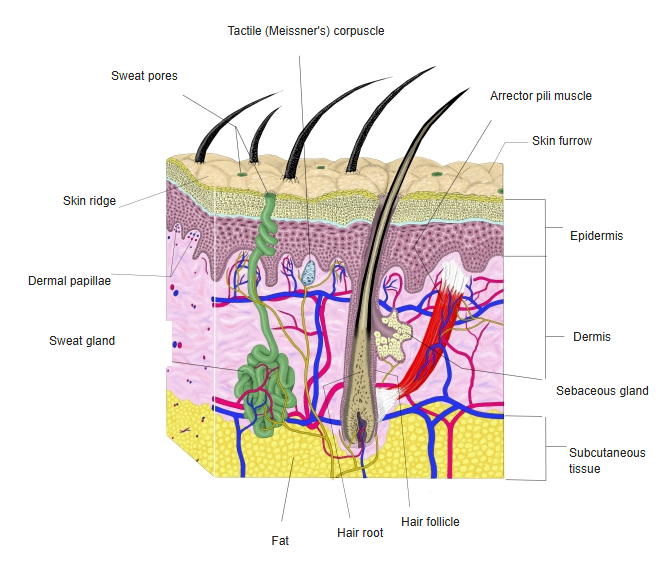
· It is most numerous where the skin is especially sensitive to light touch: the fingertips, palms, soles, lips, tongue, face and the external genitalia.
· One or more myelinated nerve fibres enter the corpuscle, lose their myelin and wind their way through it between the layers as bare endings.
Function
A slight deformation of the corpuscle starts action potentials in the nerve. The corpuscle adapts rapidly: the action potentials soon fade and stop while the pressure stays the same, and when the stimulus is removed the corpuscle springs back into shape and fires again. This is why we stop feeling our clothes. Because it lies near the surface of the dermis, it senses light touch and low-frequency vibration; fine touch, texture and reading Braille depend on it. Deep pressure and fast vibration are sensed by the lamellar (Pacinian) corpuscles deeper in the skin, and pain by free nerve endings. The number of Meissner's corpuscles falls with age.
Reference websites
[Wikipedia]
· Tactile corpuscle, Wikipedia.
· Mechanoreceptor, Wikipedia.
[Websites with illustrations]
· Receptors in the skin (Neuroanatomy online (UTHealth))

· Sensory receptors in the skin (Alamy)

· Tactile corpuscle (Blausen) (Wikimedia Commons)

Related terms
References and sources
- Further reading: Tactile corpuscle, Wikipedia.
- Further reading: Mechanoreceptor, Wikipedia.
- Federative International Programme for Anatomical Terminology (FIPAT). Terminologia Anatomica, 2nd ed. (TA2), 2019.