Stria of Retzius
Also called Striae of Retzius or the incremental lines of Retzius or the brown striae
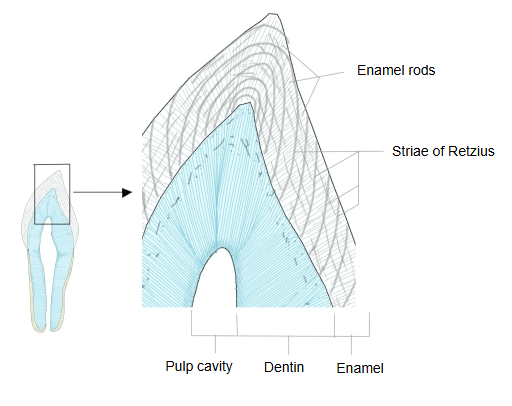
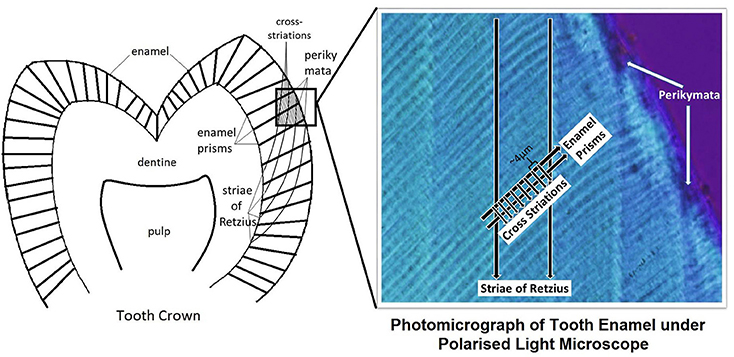
· They are one of the growth (incremental) lines of enamel. They are long-period lines: each marks roughly 6-11 days of enamel formation (the interval varies between people), while the short daily lines along the enamel rods are the cross-striations.
· They are seen in ground sections of enamel under the light microscope. In a longitudinal section they run obliquely from the dentinoenamel junction towards the surface, arching over the cusp or incisal edge; where they reach the surface they end in shallow grooves, the perikymata, seen as fine horizontal lines on the front teeth.
· They are thought to reflect a regular slowing of enamel formation by the ameloblasts. Illness such as fever makes some striae darker; the neonatal line, made by the stress of birth, is the most prominent one. They are named after the Swedish anatomist Anders Retzius.
Reference websites
[Wikipedia]
· Striae of Retzius, Wikipedia.
· Anders Retzius, Wikipedia.
· Tooth enamel, Wikipedia.
[Websites with illustrations]
· Incremental lines in enamel (figure) (Frontiers in Physiology)
· Striae of Retzius (textbook figure) (Jaypee Brothers)

Related terms
References and sources
- Further reading: Striae of Retzius, Wikipedia.
- Further reading: Tooth enamel, Wikipedia.
- Federative International Programme for Anatomical Terminology (FIPAT). Terminologia Anatomica, 2nd ed. (TA2), 2019.