Fibrous appendix of liver (Latin: appendix fibrosa hepatis)
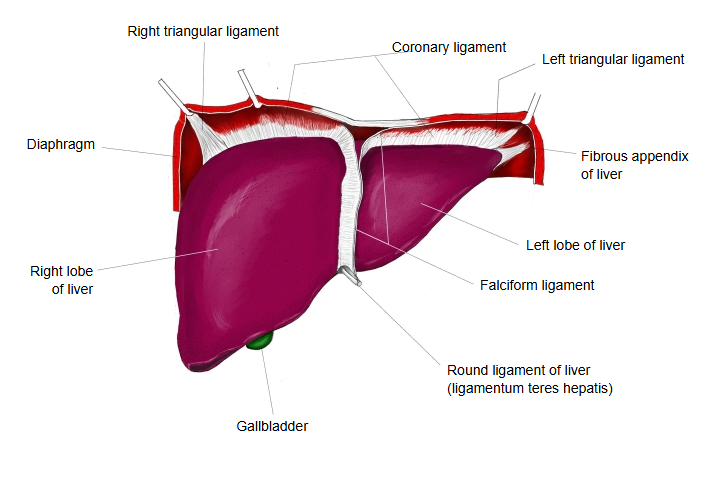
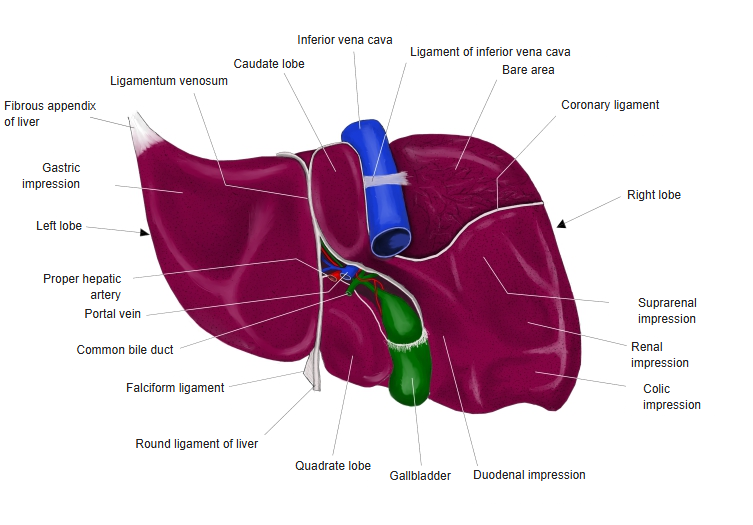
The fibrous appendix of liver is the fibrous band joining the liver to the diaphragm, found at the far left end of the left lobe of the liver.
It lies at the left end of the left triangular ligament and continues it towards the diaphragm
· Some anatomy texts describe it as present only occasionally, so it may not be a constant structure; it is small and not always clearly seen. It is thought to be a remnant of liver tissue that regressed during development, and a few bile ductules may remain inside it.
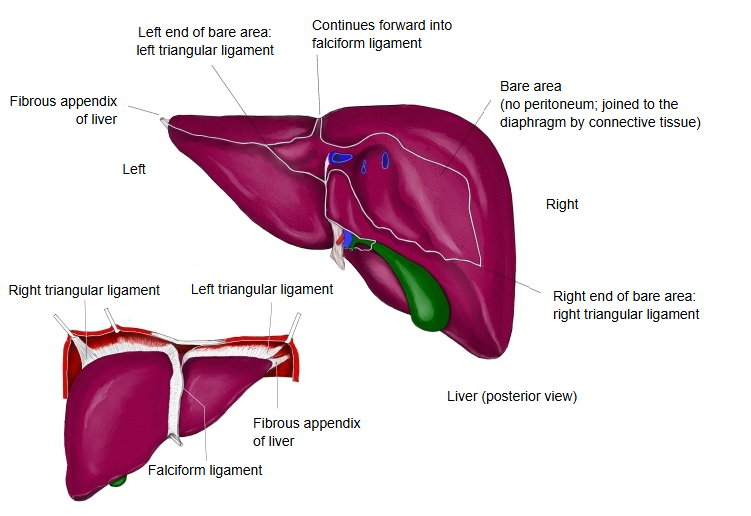
 Liver (anterior)
 Liver (visceral surface)
Reference websites
[Wikipedia]
· Liver, Wikipedia.
[Websites with illustrations]
· Liver, posterior view (Abdominal Key)
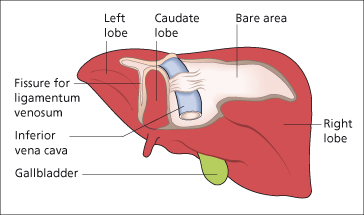
· Human liver anatomy (Shutterstock)

Related terms
- Left triangular ligament
- Triangular ligaments
- Bare area
- Round ligament of liver
- Left lobe of liver
- Liver
- Diaphragm
References and sources
- Further reading: Liver, Wikipedia.
- Federative International Programme for Anatomical Terminology (FIPAT). Terminologia Anatomica, 2nd ed. (TA2), 2019.