Gap junction
Also called the nexus or the communicating junction
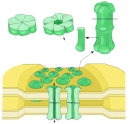 Electrical synapse (diagram 1)
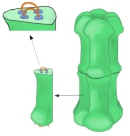 Connexons and connexin
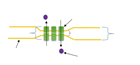 Electrical synapse (diagram 2)
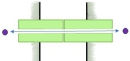 Electrical synapse (diagram 3)
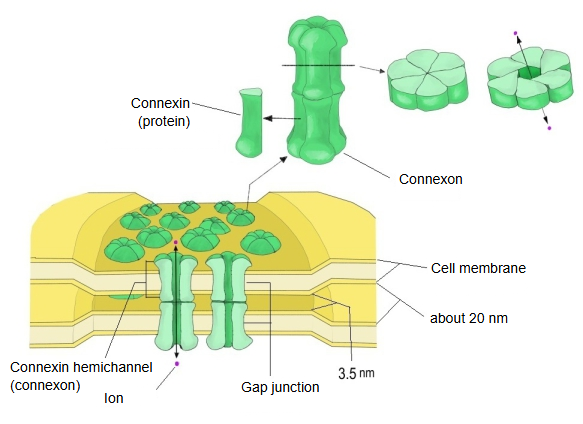
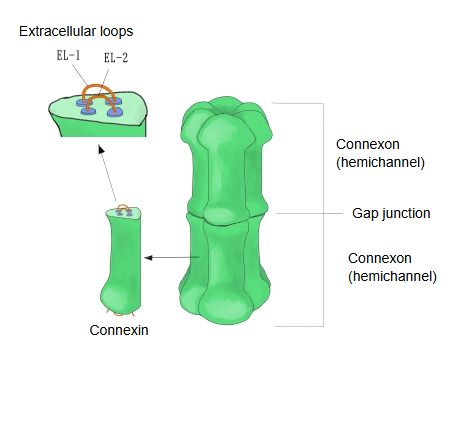
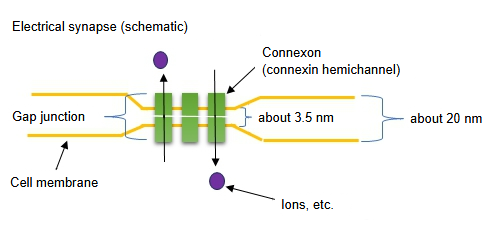
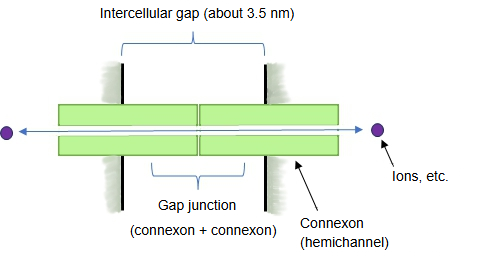
A gap junction links neighbouring cells and lets small water-soluble ions and molecules pass between them. At the junction the plasma membranes of the two cells come within about 2-4 nm of each other, much closer than usual. Each membrane carries many connexons (hemichannels), each a ring of six connexin proteins around a central pore; two connexons meet end to end to form one channel, and hundreds of channels cluster in a patch. Through these channels inorganic ions, sugars, amino acids and second messengers move directly from the cytoplasm of one cell to that of the next; large molecules such as proteins cannot pass. Because they couple cells electrically, gap junctions let impulses spread through cardiac muscle (in the intercalated discs) and smooth muscle; they also form electrical synapses between some neurons (synapse), and occur in many epithelia, in bone cells and between glial cells.
Reference websites
[Wikipedia]
· Gap junction, Wikipedia.
· Connexon, Wikipedia.
Related terms
References and sources
- Further reading: Gap junction, Wikipedia.
- Further reading: Connexon, Wikipedia.
- Federative International Programme for Anatomical Terminology (FIPAT). Terminologia Anatomica, 2nd ed. (TA2), 2019.