Electrical synapse
Also called a non-vesicular synapse or gap-junction synapse
· When people simply say "synapse", they usually mean the other kind, the chemical synapse.
- Chemical synapse
(vesicular synapse) : a neurotransmitter is released between the cells in one direction only (presynaptic cell → postsynaptic cell). Examples: between neurons; from a neuron to a muscle - Electrical synapse
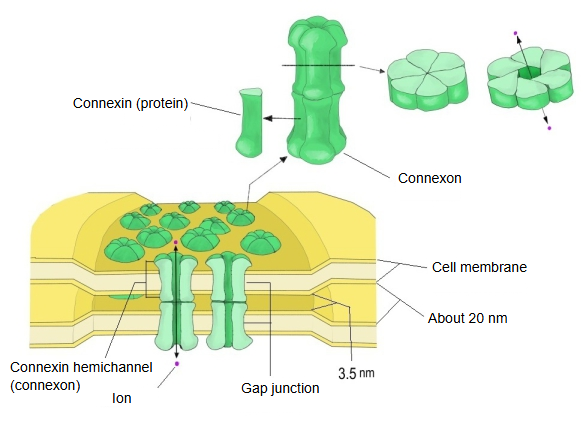
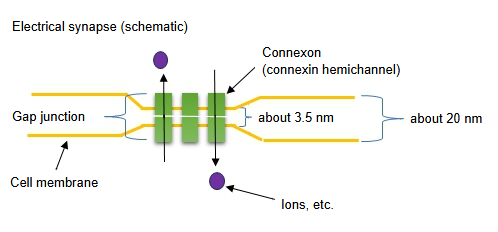
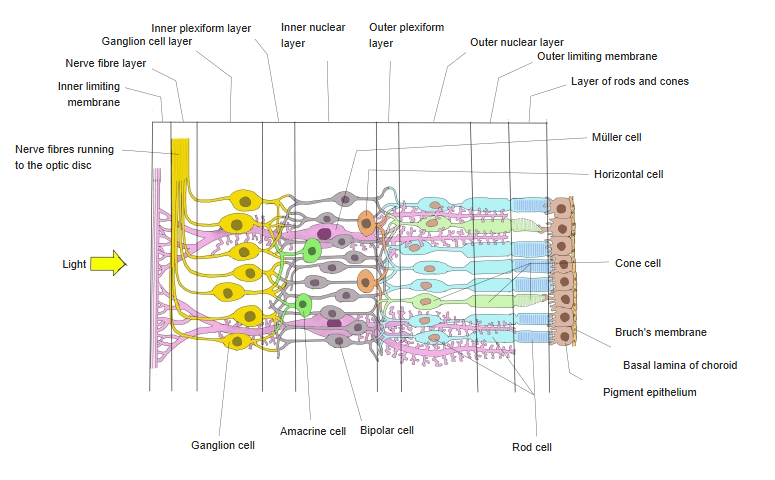
(non-vesicular synapse) : the cells are joined by channels called connexons, and ions and other particles carry the signal in both directions. Examples: neurons of the retina; the gap junctions between cardiac muscle cells work in the same way - Mixed synapse : chemical and electrical transmission at the same synapse
· The six connexins of a connexon surround a central pore. A slight change in their arrangement opens or closes the pore (a rise in the calcium ion concentration inside the cell, or in acidity, tends to close it);
while it is open, ions and small molecules pass through it in both directions.
· They do not give the one-way, directed transmission of a chemical synapse (most pass current in both directions), but they transmit faster,
and they let many cells work together in synchrony.
· At a chemical synapse the two membranes are about 20–40 nm apart; at an electrical synapse the connexons bring the two cell membranes
to within about 2–4 nm of each other, so they are extremely close.
· The pores open and close as the connexons change shape, for example in response to the calcium ion concentration.
· In the brain and spinal cord they help groups of neurons fire together; in the human nervous system they are less common than chemical synapses.
· Similar gap junctions couple smooth muscle cells.
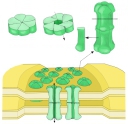 Electrical synapse (diagram 1)
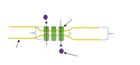 Electrical synapse (diagram 2)
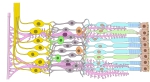 Structure of the optic part of the retina
Reference websites
[Wikipedia]
· Electrical synapse, Wikipedia.
· Gap junction, Wikipedia.
[Websites with illustrations]
· Gap junction (diagram) (Wikimedia Commons)

· Synapses (TeachMePhysiology)
Related terms
References and sources
- Further reading: Electrical synapse, Wikipedia.
- Federative International Programme for Anatomical Terminology (FIPAT). Terminologia Anatomica, 2nd ed. (TA2), 2019.